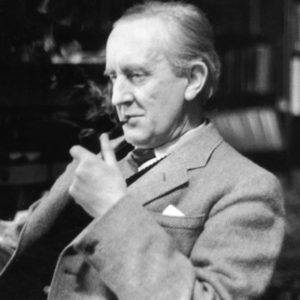
J. R. R. Tolkien stands as the central imaginative force among the Inklings, the figure whose creative achievement most fully realized the group’s shared conviction that myth and story are indispensable to human understanding. A philologist by training and a storyteller by vocation, Tolkien united rigorous linguistic scholarship with an unparalleled capacity for myth-making. Where others in the circle explored theology, philosophy, or allegory more directly, Tolkien embedded these concerns within vast, internally coherent narratives that feel less invented than discovered.
Born in 1892 in South Africa and raised in England, Tolkien spent much of his academic career at the University of Oxford, specializing in Old and Middle English. His deep engagement with ancient languages and literatures—particularly works like Beowulf—shaped not only his scholarly output but also the texture of his fiction. For Tolkien, language was the seed of story; entire cultures, histories, and mythologies grew organically from the sounds and structures of invented tongues. This approach distinguishes his work from most modern fantasy, giving it a depth and realism that continues to set the standard for the genre.
His major works, The Hobbit and The Lord of the Rings, are not merely adventures but explorations of enduring themes: the corrupting nature of power, the dignity of humility, the persistence of hope in the face of overwhelming darkness. Tolkien resisted allegory in the narrow sense, yet his Catholic faith informs the moral and metaphysical structure of his stories. Concepts such as providence, sacrifice, and the ultimate triumph of good are woven into the fabric of Middle-earth without reducing the narrative to a simple moral code.
Within the Inklings, Tolkien’s role was both generative and exacting. He was a meticulous critic of his friends’ work, including that of C. S. Lewis, and expected a high standard of internal consistency and linguistic plausibility. At the same time, his own readings of drafts—often delivered in lengthy installments—were a defining feature of the group’s meetings. His essay “On Fairy-Stories” articulates his theory of “sub-creation,” the idea that human beings, made in the image of a Creator, participate in creation through the making of secondary worlds.
Tolkien’s legacy is immense, but it is also frequently misunderstood. His work is sometimes reduced to escapism or genre fiction, when in fact it represents a profound engagement with history, language, and the nature of reality itself. Within the Inklings, he embodies the conviction that myth is not a retreat from truth, but one of its most powerful vehicles.
Tolkien Month
- S3E41 – Bonus – The “Tolkien” Movie
- S3E42 – AH – “After Hours” with The Prancing Pony
- S3E43 – AH – “After Hours” with The Tolkien Road
- S3E44 – AH – “After Hours” with Joseph Loconte
- S3E45 – AH – “After Hours” with Tea With Tolkien
- S3E46 – AH – “After Hours” with Diana Glyer (Part 1)
- S3E47 – AH – “After Hours” with Diana Glyer (Part 2)
- S3E48 – Bonus – Mythopoeia
- The Digital Tolkien Project
Other Resources
- Classical Stuff You Should Know
- Tolkien Podcasts
- Oxford Center for Fantasy