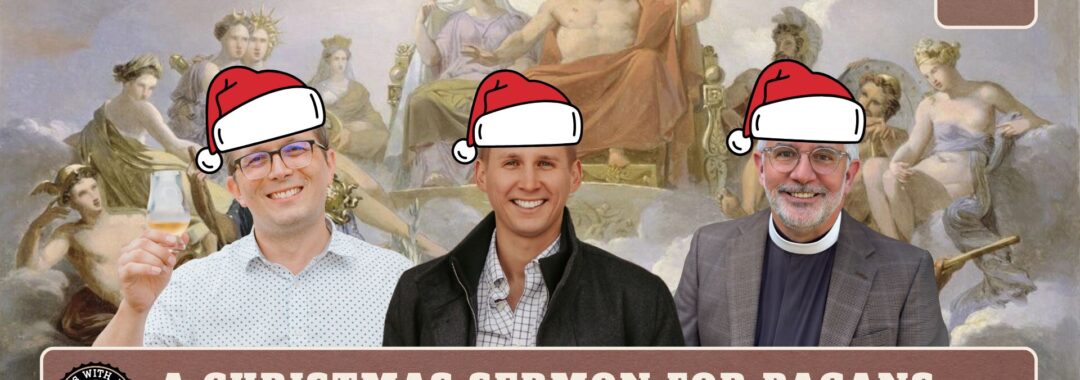
To celebrate Christmas this year, the gang discuss the recently-discovered Lewis work, “A Christmas Sermon for Pagans”.
Click here to download audio for S9E8: “A Christmas Sermon for Pagans”
Show Notes
Quote-of-the-Week
When I was asked to write a Christmas sermon for Pagans I accepted the job lightheartedly enough: but now that I sit down to tackle it I discover a difficulty. Are there any Pagans in England for me to write to?
– C. S. Lewis, A Christmas Sermon for Pagans
Introduction
In past years we’ve discussed Lewis’ essay What Christmas means to me, as well as Xmas and Christmas: A lost chapter from Herodotus (The C. S. Lewis Podcast Episode | The Lorehaven Episode). Today we’ll be discussing “A Christmas Sermon for Pagans” which is actually a rather good preparation for The Abolition of Man in the New Year with themes of truth and mastery of nature…
Chit Chat
- Andrew referenced Xmas and Christmas: A lost chapter from Herodotus where Lewis speaks of “Naitirb”, which is “Britain” backwards. Lewis uses backward names also in Till We Have Faces
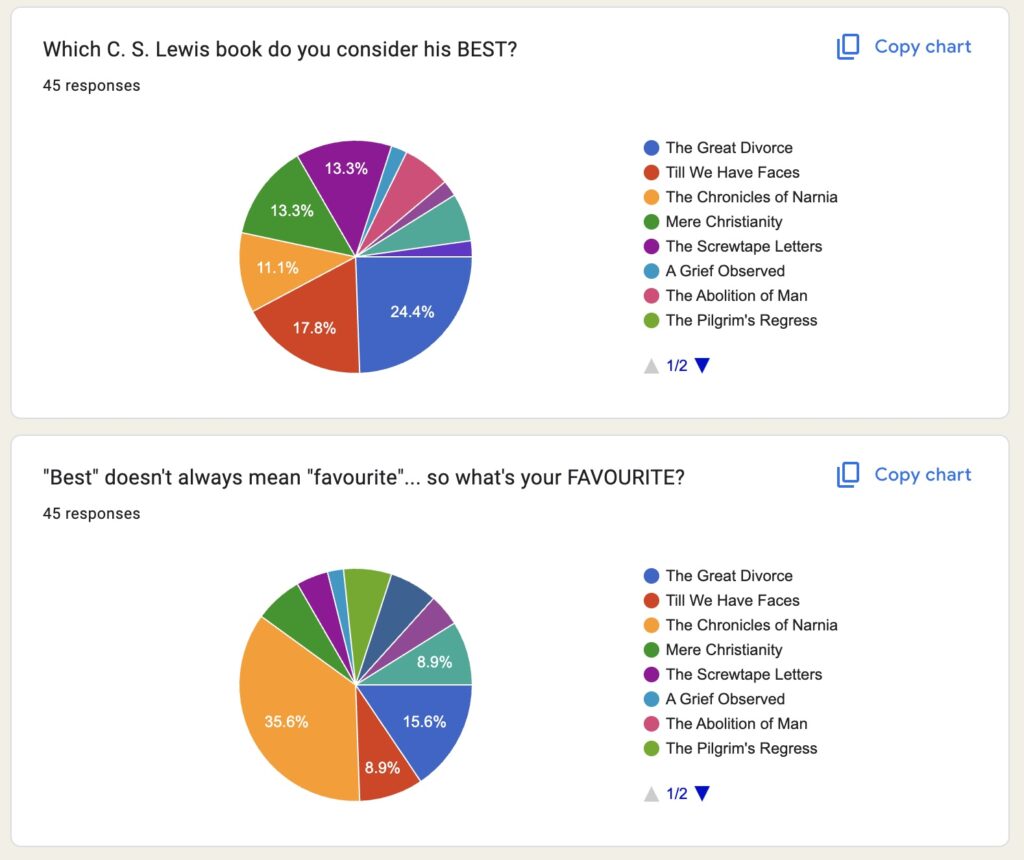
- Matt talked about the popularity of our Till We Have Faces Primer episode as well as a listener survey regarding the Best and Favourite C. S. Lewis work:
- Andrew has nearly finished his dissertation, as well as a big project.
- Matt’s baby is at ~34 weeks gestation
- David’s friend, Joe has just had his second child, Samuel Benedict
- It was the anniversary of Andrew meeting his future wife, Christin
- We recorded this episode soon after #CSLewisReadingDay
Toast
- Andrew was drinking coffee in a Christmas mug
- Matt was sipping a yerba mate tea
- David was enjoying a hot chocolate
Discussion
01. “Background”
Q. Does anyone know the background to this essay we’re going to discuss today?
- This essay was lost for a long time. Lewis wrote the essay in 1946, but while preparing to do research for her PhD, Stepanie Derrick discovered two entries in The Strand magazine index referring to previously unknown Lewis essays, one of which was A Christmas Sermon for Pagans.
- The Strand was a very popular magazine. It was where most readers first encountered Sherlock Holmes
- Lewis actually mentions the magazine in That Hideous Strength (Chapter 17).
02. “What’s a Pagan?”
Q. What prompted Lewis to write this essay?
- He appears to have been asked by the magazine and given the title
Q. How did Lewis underestimate the challenge?
- He thought it was going to be easy, but when he tried to begin writing it he asked himself Are there any Pagans in England for me to write to?
Q. As we’d expect, Lewis wants to “describe and define”. What does it mean to be “pagan”?
- Lewis points out that some people use the term “Pagan” to describe those who are post-Christian. When they say that England is ceasing to be Christian, they describe it as becoming Pagan again.
- Historically, “Pagan” and “Heathan” referred to those who lived in the country (a “rustic” or “yokel.”)
- Pagan was a man who lived in a Pagus or small village
- Heathen is an interchangeable term and means a man who lived out on the heath
- The term came about after the Roman Empire were Christianised the larger towns, meaning that most who were still following the old gods lived in the country
03. “What’s the difference?”
Q. So is there a difference between being Pagan in the past (i.e. pre-Christian) and being “Pagan” today (i.e. post-Christian)?
- Lewis says there is! To say that modern people who have drifted away from Christianity are Pagans is to suggest that a post-Christian man is the same as a pre-Christian man. However, he makes his point with a couple of analogies to show that they are alike in some ways, but very different in others.
- Andrew spoke about De Descriptione Temporum (1954).
Q. So in what ways are they different?
- The Pagan was full of reverence for the natural world
- To him the earth was holy, the woods and waters were alive. His agriculture was a ritual as well as a technique.
- The Post-Christian regards Nature as a kind of machine for us to exploit
- He believed in an objective moral law
- He thought the distinction between pious and impious acts was something which existed independently of human opinions
- Lewis uses the same analogy he uses in Mere Christianity of the multiplication table – it’s not invented but discovered..
- This isn’t exactly the same morality as Christian morality, but there was significant overlap (see The Tao described in the Appendix of The Abolition of Man)
- The Post-Christian doesn’t believe in objective morality, thinking each race or class can invent its own code or “ideology” just as it pleases
- He thought the distinction between pious and impious acts was something which existed independently of human opinions
- The Pagan had a sense of sin
- Lewis notes that although the morality of Paganism was sometimes rather “low”, it was often too high for the Pagan to achieve!
When he asked himself what was wrong with the world he did not immediately reply, “the social system,” or “our allies,” or “education.” It occurred to him that he himself might be one of the things that was wrong with the world. He knew he had sinned. Jack notes that the Pagan gods made no distinction between voluntary and involuntary sins. The human had to perform the necessary ceremonies to take away the guilty, but…they never quite succeeded. His conscience was not at ease.
C. S. Lewis, A Christmas Sermon for Pagans
- The Post-Christian doesn’t think anything is his fault:
And whatever may be amiss with the world, it is certainly not we, not the ordinary people; it is up to God (if, after all, He should happen to exist), or to Government or to Education, to give us what we want. They are the shop, we are the customers: and ‘the customer is always right.’
C. S. Lewis, A Christmas Sermon for Pagans
04. “What has been lost?”
Q. What has the Post-Christian gained?
- Freedom and no more restraints, but only if the post-Christian view is correct!
Q. What has the Post-Christian lost?
- They’ve lost fun! He says…
A universe of colourless electrons (which is presently going to run down and annihilate all organic life everywhere and forever) is, perhaps, a little dreary compared with the earth-mother and the sky-father, the wood nymphs and the water nymphs, chaste Diana riding the night sky and homely Vesta flickering on the hearth.
C. S. Lewis, A Christmas Sermon for Pagans
- …but you can’t have everything, and at least we can spend our time with entertainment (movies etc.)
05. “Does post-Christianity seem to be true?”
Q. Lewis then turns to the question of whether or not the post-Christian worldview is actually true. Why does he seem to doubt it is?
- Shouldn’t the world be better? He gives the example of famine around the world. He asks…
Can it be that Nature (or something behind Nature) is not simply a machine that we can do what we like with?—that she is hitting back?
C. S. Lewis, A Christmas Sermon for Pagans
Q. Jack suggests we waive this point and move on. If Nature is indeed just a machine which we can choose to master, are we actually seeing the opposite, namely that Man’s conquest of Nature is really Man’s conquest of Man?
Echoing Chapter 3 of The Abolition of Man, He points out that…
…every power wrested from Nature is used by some men over other men…each new victory ‘over Nature’ yields new means of propaganda to enslave them, new weapons to kill them, new power for the State and new weakness for the citizen, new contraceptives to keep men from being born at all
C. S. Lewis, A Christmas Sermon for Pagans
Q. Why does Jack think we should be suspicious about the veracity of the claim about right and wrong?
- If we invent Right and Wrong, no ideology can be better or worse than another.
For a better moral code can only mean one which comes nearer to some real or absolute code. One map of New York can be better than another only if there is a real New York for it to be truer to. If there is no objective standard, then our choice between one ideology and another becomes a matter of arbitrary taste. Our battle for democratic ideals against Nazi ideals has been a waste of time, because the one is no better than the other. Nor can there ever be any real improvement or deterioration: if there is no real goal you can’t get either nearer to it or farther from it. In fact, there is no real reason for doing anything at all.
C. S. Lewis, A Christmas Sermon for Pagans
06. “Becoming Pagans Again”
Q. Lewis concludes with a rather surprising proposition… what is it?
- We need to become Pagan once more…but then become Christians again. He tells us what he doesn’t mean..
I don’t mean that we should begin leaving little bits of bread under the tree at the end of the garden as an offering to the Dryad. I don’t mean that we should dance to Dionysus across Hampstead Heath (though perhaps a little more solemn or ecstatic gaiety and a little less commercialised “amusement” might make our holidays better than they now are). I don’t even mean (though I do very much wish) that we should recover that sympathy with nature, that religious attitude to the family, and that appetite for beauty which the better Pagans had. Perhaps what I do mean is best put like this.
C. S. Lewis, A Christmas Sermon for Pagans
- If the modern post-Christian view is wrong (and the Christian worldview right), the world is automatically grouped into three people:
- (1) Those who are sick and don’t know it (the post-Christians)
- (2) Those who are sick and know it (Pagans)
- (3) Those who have found the cure.
- Jack’s point is that you can’t get to (3) without first going through (2), with Christianity fixing/curing Paganism:
For (in a sense) all that Christianity adds to Paganism is the cure. It confirms the old belief that in this universe we are up against Living Power: that there is a real Right and that we have failed to obey it: that existence is beautiful and terrifying. It adds a wonder of which Paganism had not distinctly heard—that the Mighty One has come down to help us, to remove our guilt, to reconcile us.
C. S. Lewis, A Christmas Sermon for Pagans
- Lewis ends by suggesting, isn’t it worth giving Christmas a go?
All of the world (even in Japan, even in Russia) men and women will meet on December 25th to do what is a very old-fashioned and, if you like, a very Pagan thing—to sing and feast because a God has been born. You are uncertain whether it is more than a myth. Well if it is, then our last hope is gone. But is the opposite explanation not worth trying? Who knows but that here, and here alone, lies your way back not only to Heaven, but to Earth too, and to the great human family whose oldest hopes are confirmed by this story that does not die?
C. S. Lewis, A Christmas Sermon for Pagans
When grave persons express their fear that England is relapsing into Paganism, I am tempted to reply, ‘Would that she were.’ For I do not think it at all likely that we shall ever see Parliament opened by the slaughtering of a garlanded white bull in the House of Lords or Cabinet Ministers leaving sandwiches in Hyde Park as an offering for the Dryads. If such a state of affairs came about, then the Christian apologist would have something to work on. For a Pagan, as history shows, is a man eminently convertible to Christianity. He is essentially the pre-Christian, or sub-Christian, religious man. The postChristian man of our day differs from him as much as a divorcee differs from a virgin.
C. S. Lewis, Is Theism Important? (God In The Dock)
- Regarding the supposed Pagan origins of Christmas, David recommended Inspiring Philosophy:
07. “Xmas Question: Longed-for Presents”
Q. Was there a gift you desperately wanted but never got—or finally did?
- Matt: A snuggie
- David: A PC
- Andrew: A puppy
08. “Xmas Question: Imported Gifts”
Q. Are there traditions you’ve adopted from your spouse’s family?
- Andrew: Epiphany Celebration
- Matt: Santa Hunting
- David: Xmas Eve Celebration
09. “Xmas Question: Meaningful Material”
Q. Is there a Christmas passage, hymn, or idea that resonates with you?
- David: I heard the Bells on Christmas Day poem and song
- Matt: It’s A Wonderful Life and The Christmas Shoes
- Andrew: Explaining Joy in terms of Advent and Christmas
10. “Xmas Question: Erasing Music”
Q. If you could delete one Christmas song from existence, which would it be?
Matt
Mistletoe by Justin Bieber
Andrew
Wonderful Christmastime by Paul McCartney
David
All I Want for Christmas Is You by Mariah Carey
Wrap Up
Concluding Thoughts
–
Support Us!
- Subscribe to the audio feed on your preferred podcast platform, such as iTunes, Google Podcasts, Spotify, Audible, and many others…
- Follow us on Instagram, Facebook, YouTube, and Twitter
- See what we have planned for the rest of Season 9
- We would be grateful if new listeners would rate and review us on their preferred podcast platform.
- Finally, if you’d like to support us and get fantastic gifts such as access to our Pints With Jack Slack channel and branded pint glasses, please join us on Patreon for as little as $2 a month.