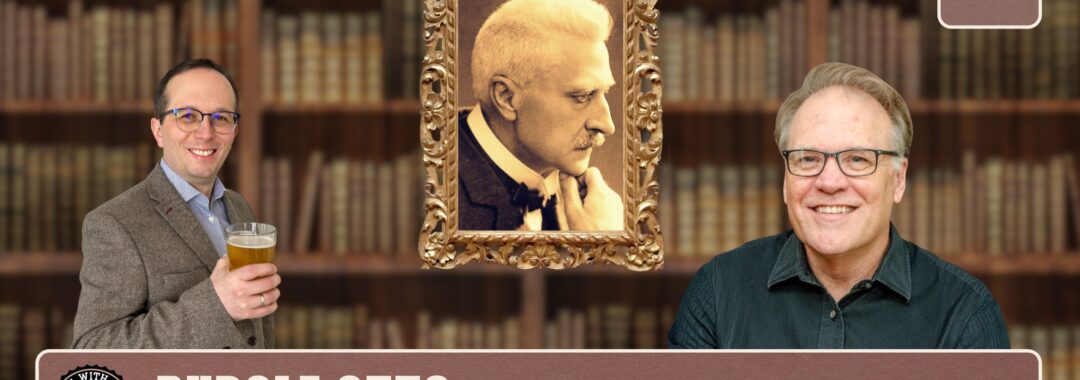
We wrap up Jack’s Bookshelf by exploring a writer you may well have never heard of…
Click here to download audio for S9E30: “Jack’s Bookshelf – Rudolf Otto”
Show Notes
Quote-of-the-Week
“…..mysticism leads to a valuation of the transcendent object of its reference as that which through plenitude of being stands supreme and absolute, so that the finite self contrasted with it becomes conscious even in its nullity that ‘I am naught, Thou art all’.”
– Rudolf Otto, The Idea of the Holy
Introduction
Today Jack’s Bookshelf draws to a close, and with an author with whom you may be unfamiliar. In 1962, The Christian Century asked Lewis the following question: “What books did most to shape your vocational attitude and your philosophy of life?” His answer includes books by several authors which we’ve already explored on Jack’s Bookshelf: George MacDonald, G. K. Chesterton, William Wordsworth, Boethius and Charles Williams.
However, one name you may well be unfamiliar: Rudolf Otto… and introducing him to us today is Dr. Joe Ricke.
Biographical Information
Dr. Ricke is an American scholar of English literature. He earned his Ph.D. and M.A. in English from Rice University and a B.A. from Nyack College.
His research spans Shakespeare, early drama, medieval and Renaissance literature, the Inklings, especially C. S. Lewis, world literature in translation, and the role of Christian higher education.
He was previously Professor of English and Director of The Center for the Study of C. S. Lewis and Friends at Taylor University in Indiana. He is the host of the Inkling Folk Fellowship, a friendly but thoughtful literary conversation circle every Friday, focusing primarily on the writings of the Inklings and others of their ink-ilk
Chit Chat
–
Toast
–
Discussion
01. “The Man”
Q. Who was Rudolf Otto? What do we know about him and where does he fit into the world of books?
–
Q. What makes him an important author?
–
Q. When did you first come across him and what got you interested?
Suppose you were told there was a tiger in the next room: you would know that you were in danger and would probably feel fear. But if you were told “There is a ghost in the next room,” and believed it, you would feel, indeed, what is often called fear, but of a different kind. It would not be based on the knowledge of danger, for no one is primarily afraid of what a ghost may do to him, but of the mere fact that it is a ghost. It is “uncanny” rather than dangerous, and the special kind of fear it excites may be called Dread. With the Uncanny one has reached the fringes of the Numinous. Now suppose that you were told simply “There is a mighty spirit in the room,” and believed it. Your feelings would then be even less like the mere fear of danger: but the disturbance would be profound. You would feel wonder and a certain shrinking—a sense of inadequacy to cope with such a visitant and of prostration before it—an emotion which might be expressed in Shakespeare’s words “Under it my genius is rebuked.” This feeling may be described as awe, and the object which excites it as the Numinous.
The Problem of Pain (Chapter 1)
Q. We’ll talk about his influence on Lewis shortly, but what do we know about his owninfluences?
–
02. “His Works”
Q. Would you mind just guiding us through his corpus?
–
Q. “The Idea of the Holy” is his most well-known work, so would you mind outlining the case he makes in that book?
“I’ve no use for all that stuff. But, mind you, I’m a religious man too. I know there’s a God. I’ve felt Him: out alone in the desert at night: the tremendous mystery. And that’s just why I don’t believe all your neat little dogmas and formulas about Him. To anyone who’s met the real thing they all seem so petty and pedantic and unreal!”
C. S. Lewis, Mere Christianity (Book IV, Chapter 1)
03. “Influencing Lewis”
Q. So, the big question, how did he influence C. S. Lewis?
–
04. “First Steps”
Q. If someone wanted to dip their toe into Otto’s works, where would you recommend people begin?
–
Magdalen College, Oxford, Jan 25th, 54
Dear Dr. Pieper
Thank you for your letter of the 23d. I do not find any difficulty in your English writing; I am more afraid that, thanks to a touch of arthritis in my right wrist, you will find more in mine! 1. The Inklings were a club, so called because being all writers, they had to do with ink. This dedication has, however, already given rise to so many useless speculations that I think you should simply omit it 2. By “communicating” Christians I meant those who receive the Holy Communion. 3. C.C.S. means “Casualty Clearing Station”: not what we call an “Advanced Dressing Station,” i.e. a place where the wounded would be bandaged before being put into an ambulance, but the hospital proper (i.e. with beds, operating theatre etc.) which is nearest to the Front Line. You no doubt have a word for this. 4. Yes, certainly omit the Appendix. 5. I do not think that the propriety of quoting from The Wind in the Willows depends at all on whether the reader knows it. The purpose was to show the experience of the Numinous springing up in a modern author who is not writing on religion. I do not think Otto quotes anything of the sort, and this evidence for the sense of the Numinous as a permanent human datum, not something confined either to saints or to savages, is to me important. I am merely asking you to reconsider your decision. If you still disagree with me, I shall of course acquiesce. Thank you for the kind things you say about my little book. Please accept my sincere compliments to yourself and to Frau Doktor Pieper,
Yours sincerely, / C. S. Lewis
Wrap Up
Closing Thoughts
–
More Information
–
Support Us!
- Subscribe to the audio feed on your preferred podcast platform, such as iTunes, Google Podcasts, Spotify, Audible, and many others…
- Follow us on Instagram, Facebook, YouTube, and Twitter
- See what we have planned for the rest of Season 9
- We would be grateful if new listeners would rate and review us on their preferred podcast platform.
- Finally, if you’d like to support us and get fantastic gifts such as access to our Pints With Jack Slack channel and branded pint glasses, please join us on Patreon for as little as $2 a month.