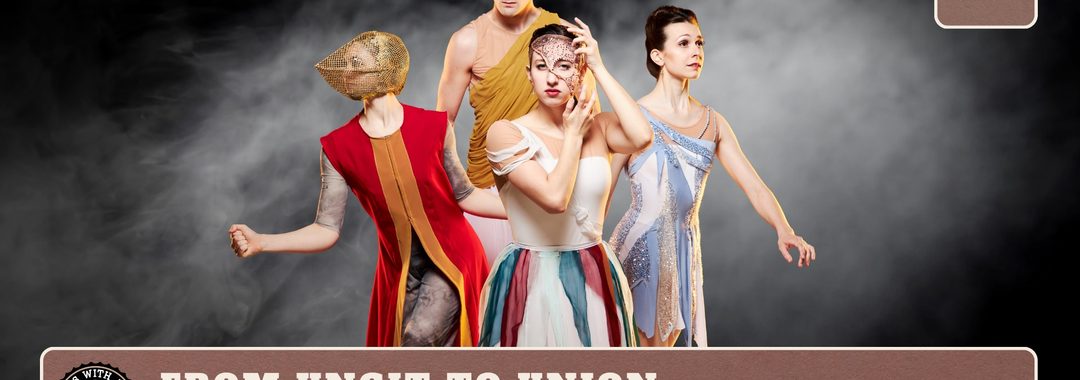
This is a re-recording of a keynote talk given by David on March 14th at “Thick & The Clear: C.S. Lewis and the Arts”, a conference at Wheaton College hosted by Ballet 5:8.
Show Notes
01. “Welcome”
- David was invited by Ballet 5:8, a Christian ballet company, to make a presentation at their conference called “From Ungit to Union”, delving into the story of Til We Have Faces, as well as “thick” and “clear” religions culminating in Christianity. “Why not Andrew?” you cry! Well, you’ll just have to listen through to see how David handles Andrew’s favorite book.
“Child, to say the very thing you really mean, the whole of it, nothing more or less or other than what you really mean; that’s the whole art and joy of words.”
-The Fox, Til We Have Faces
02. “About Me”
- David is from England. He has no advanced degrees in literature related fields, but studied Computer Science. That being said, he is a lover of literature, truly an “amateur”!
- David rediscovered Lewis in his 20s.
- PWJ podcast began with reading through Mere Christianity, but eventually the time came to discuss Til We Have Faces, David’s first reading of the work. This called for an invitation to someone who loves TWHF, Rev. Dr. Andrew Lazo.
- Lewis’ best book? David says The Great Divorce, Andrew saying TWHF.
03. “The Agenda”
- Exploring the “thick” and the “clear” as literary expression
- The union and fulfillment of both in Christianity
04. “Part I — Till We Have an Overview”
- A whistle stop tour through the novel
- Meet Orual and her dysfunctional family who are the rulers of Glome (a place which participates in the pagan and sacrificial worship of the goddess Aphrodite and her son)
- Orual (and her sister and father) deeply flawed and wounded
- She has a Greek slave for a tutor called the Fox
- The King’s new wife dies giving birth to perfect Psyche, the youngest daughter in the family
- The story continues to follow Orual’s twisted mothering of Psyche, the sacrifice of Psyche to the “god of the mountain”, and Orual’s rise to become Queen of Glome
- She is the unreliable narrator who is telling the tale at the end of her life, trying to put to words and come to honesty herself the relationship she has with the gods.
Some of the quotations mentioned by David in this section…
“Why should your heart not dance?”
“You also shall be Psyche.”
“…Psyche was mine and no one else had any right to her. Oh, you’ll say you took her away into bliss and joy such as I could never have given her, and I ought to have been glad of it for her sake. Why? What should I care for some horrible, new happiness which I hadn’t given her and which separated her from me? Do you think I wanted her to be happy, that way? It would have been better if I’d seen the Brute tear her in pieces before my eyes…. Did you ever remember whose the girl was? She was mine. Mine; do you not know what the word means? Mine!”
“You also are Psyche.”
05. “Part II — The Loveless beginning”
- We return to the beginning and spend some time on the very first page, considering what Orual has to say about herself and the loves (or rather, the lack of loves) in her life.
- Didactic prose
- Myth
- The Abolition of Man
- That Hideous Strength
- The Four Loves
- Four loves- Storge, Philia, Eros, and Agape
I am old now and have not much to fear from the anger of gods. I have neither husband nor child, nor hardly a friend, through whom they can hurt me. My body, this lean carrion that still has to be washed and fed and have clothes hung about it daily with so many changes, they may kill as soon as they please. The succession is provided for. My crown passes to my nephew.
Being, for all these reasons, free from fear, I will write in this book what no one who has happiness would dare to write. I will accuse the gods; especially the god who lives on the Grey Mountain. That is, I will tell all he has done to me from the very beginning, as if I were making my complaint of him before a judge. But there is no judge between gods and men, and the god of the mountain will not answer me. Terrors and plagues are not an answer. I write in Greek as my old master taught it to me. It may some day happen that a traveller from the Greeklands will again lodge in this palace and read the book. Then he will talk of it among the Greeks, where there is great freedom of speech even about the gods themselves. Perhaps their wise men will know whether my complaint is right or whether the god could have defended himself if he had made an answer.
-Orual, Til We Have Faces
“Love becomes a demon the moment he begins to be a god”.
-The Four Loves
We may give our human loves the unconditional allegiance which we owe only to God. Then they become gods: then they become demons. Then they will destroy us, and also destroy themselves. For natural loves that are allowed to become gods do not remain loves. They are still called so, but can become in fact complicated forms of hatred.
– The Four Loves
I wanted to be a wife so that I could have been [Psyche’s] real mother. I wanted to be a boy so that she could be in love with me. I wanted her to be my full sister instead of my half sister. I wanted her to be a slave so that I could set her free and make her rich.
– Orual, Til We Have Faces
You are indeed teaching me about kinds of love I did not know. It is like looking into a deep pit. I am not sure whether I like your kind better than hatred.
– Psyche, Til We Have Faces
Towards the end of the book Bardia’s wife, Ansit, accuses the Orual of doing the same thing to her husband, saying “your queenship drank up his blood year by year and ate out his life”.
06. “Part III — Between Ritual and Rationalism”
- Here we will look at some key moments in Lewis’ book where the Thick and the Clear arise and at the tension which exists between them.
There isn’t really… this infinite variety of religions to consider. We may… [with all respect] divide religions, as we do soups, into “thick” and “clear.” By thick I mean those which have orgies and ecstasies and mysteries and local attachments: Africa is full of thick religions. By clear I mean those which are philosophical, ethical, and universalizing: Stoicism, Buddhism, and the Ethical Church are clear religions.
– God in the Dock
- Lewis portrays “thick” religion as spiritually potent but also potentially fearful, manipulative, and morally confusing.
As he grew older he seemed to be ever less and less a philosopher, and to talk more of eloquence, and figures, and poetry.
– Orual, on the Fox
The Priest has been with me. I never knew him before. He is not what the Fox thinks. Do you know, Sister, I have come to feel more and more that the Fox hasn’t the whole truth. Oh, he has much of it. It’d be dark as a dungeon within me but for his teaching. And yet . . . I can’t say it properly. He calls the whole world a city. But what’s a city built on? There’s earth beneath. And outside the wall? Doesn’t all the food come from there as well as all the dangers? . . . things growing and rotting, strengthening and poisoning, things shining wet . . . in one way (I don’t know which way) more like, yes, even more like the House of—— Ungit.
– Psyche to Orual
- Real religion requires both imagination and truth.
…Hinduism fulfills it imperfectly. The clear religion of the Brahman hermit in the jungle and the thick religion of the neighboring temple go on side by side. The Brahman hermit doesn’t bother about the temple prostitution nor the worshiper in the temple about the hermit’s metaphysics.
But Christianity really breaks down the middle wall of the partition. It takes a convert from Central Africa and tells him to obey an enlightened universalist ethic: it takes a twentieth-century academic prig like me and tells me to go fasting to a mystery, to drink the blood of the Lord. The savage convert has to be clear: I have to be thick. That is how one knows one has come to the real religion.
– God in the Dock
…from the rising of the sun to its setting [the name of the LORD] is great among the nations, and in every place incense is offered to [His] name, and a pure sacrifice…
– the prophet Malachi
Clouds and thick darkness are round about him; righteousness and justice are the foundation of his throne.
– Psalm 97
We, who with unveiled faces contemplate the Lord’s glory, are being transformed into his image with ever-increasing glory…
– 1 Corinthians 3
07. “Part IV — Late have I loved you”
- Lastly, we will skip to the final page of this book and read the dying words of Queen Orual, to see what self-knowledge her journey has brought about, and discover how her encounters with love and the gods have transformed her.
I saw well why the gods do not speak to us openly, nor let us answer. Till that word can be dug out of us, why should they hear the babble that we think we mean? How can they meet us face to face till we have faces?
– Orual, TWHF
I ended my first book with the words No answer. I know now, Lord, why you utter no answer. You are yourself the answer. Before your face questions die away. What other answer would suffice? Only words, words; to be led out to battle against other words. Long did I hate you, long did I fear you. I might——
– Orual, TWHF
Late have I loved you, O Beauty ever ancient, ever new, late have I loved you!
You were within me, but I was outside, and it was there that I searched for you.
In my unloveliness I plunged into the lovely things which you created.
You were with me, but I was not with you.
Created things kept me from you; yet if they had not been in you they would have not been at all.
You called, you shouted, and you broke through my deafness.
You flashed, you shone, and you dispelled my blindness.
You breathed your fragrance on me; I drew in breath and now I pant for you.
I have tasted you, now I hunger and thirst for more.
You touched me, and I burned for your peace.
– St. Augustine, The Confessions