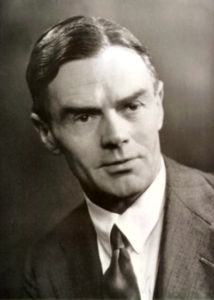
Owen Barfield is often described as the most philosophical of the Inklings, though that label risks understating both his originality and his influence. Less widely read than C. S. Lewis or J. R. R. Tolkien, Barfield nevertheless played a decisive role in shaping the intellectual foundations of the group. His concerns were not primarily narrative or apologetic, but epistemological: how human beings know, perceive, and participate in reality. In this sense, he stands somewhat apart from the other Inklings, yet also beneath them—his ideas forming a kind of philosophical substructure to their imaginative work.
Born in 1898, Barfield trained as a lawyer but devoted much of his life to writing on language, consciousness, and the evolution of meaning. His most influential work, Poetic Diction, argues that language is not a static system of arbitrary signs but a living record of human consciousness. Words, he contends, once carried unified meanings that reflected an earlier, more participatory mode of awareness—what he later called “original participation.” Over time, this unity fractured into the more analytical and detached consciousness characteristic of modernity. For Barfield, this was not simply a linguistic shift but a spiritual and intellectual transformation with profound implications.
This emphasis on participation is central to Barfield’s thought. He rejected the sharp division between subject and object that dominates modern philosophy, proposing instead that human perception actively contributes to the reality it apprehends. Reality, in his view, is not merely “out there” but is co-constituted through consciousness. This conviction placed him in dialogue—sometimes in tension—with his friend C. S. Lewis, whose early commitment to materialism Barfield famously challenged. Their debates, half-serious and half-playful, earned Barfield the nickname “the First and Last Inkling,” since he helped spark the intellectual movement that would later become the group.
Barfield’s work is demanding. It moves through philology, philosophy, and theology with a density that can resist casual reading. Yet its ambition is unusually broad: nothing less than a reconfiguration of how modern people understand meaning, imagination, and the evolution of consciousness itself. Within the Inklings, Barfield represents a different kind of imagination—not the crafting of worlds, but the interrogation of the very conditions that make imagination possible.
Official Owen Barfield website, OwenBarfield.org.
Owen Barfield Month
In Sesason 4, we devoted a month to Owen Barfield:
Other Resources
Podcasts
- The Inklings Variety Hour
- Lesser-Known Lewis
- Mythmakers: Oxford Center for Fantasy
- The Plunge
Videos
- The Plunge