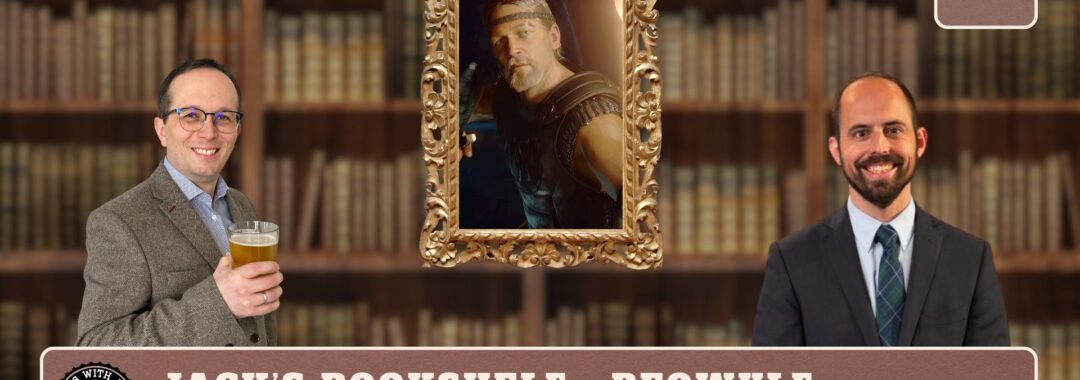
It’s time snoop through Jack’s Bookshelf and it’s time for monster stories! Welcome to Beowulf with Dr. Ben Reinhard…
Click here to download audio for S9E27: “Beowulf”
Show Notes
Quote-of-the-Week
Fate goes ever as fate must.
Beowulf
Introduction
Welcome friends to Pints With Jack! Today we begin Jack’s Bookshelf, a month dedicated to the authors and books which shaped the mind and imagination of C. S. Lewis, and we begin with a really fun work, “Beowulf”.
Biography
Dr. Ben Reinhard is a professor of English at the Franciscan University of Steubenville after nine years at Christendom College, where he served as English department faculty, Director of the Advanced Studies Program, and Academic Dean.
He is originally from Bluffton, Indiana and lives in Steubenville with his wife Hannah and their five children.His research focuses on Anglo-Saxon literature and culture, Middle English literature, and the Inklings, and he has already appeared on Pints With Jack, discussing his book, “The High Hallow: Tolkien’s Liturgical Imagination”.
Chit Chat
Q. You have been on the show in April 2025 to discuss your work “The High Hallow: Tolkien’s Liturgical Imagination”. What have you been up to since then?
- It’s been a busy eight months! Dr. Reinhard just wrapped up an insane semester teaching schedule, and he also just completed his part in a project on C. S. Lewis’s connection to Christopher Dawson.
- Christopher Dawson was among the most important of the 20th century medievalist historians and social critics. He’s known for works like “Christianity and the New Age”, “Religion and the Modern State”, and “Progress and Religion”, a text that was instrumental in forming the thought of T. S. Elliot and J. R. R. Tolkien. Dawson is the very unfortunately forgotten character who was connected to a lot of more prominent names, including the before mentioned, as well as Dorothy Sayers and David Jones.
Toast
Q. Are you drinking anything today? Please say mead…
- Dr. Reinhard did indeed have mead!
- In honor of Beowulf and strong men with great beards, David drank Beards Brewery Brown Ale.
Discussion
01. “Discovering Adventure”
Q. When did you first come across Beowulf and what got you interested?
- Dr. Reinhard first encountered the epic poem during his undergraduate years after receiving it as a Christmas present. The story was immediately fascinating.
- Shortly after, he took a course that featured the tale prominently. The influence of this work and this class are primarily what drew Dr. Reinhard to pursue his graduate degree.
02. “Learning Anglo-Saxon”
Q. You said Anglo-Saxon poetry was attractive to you. Had you already begun to learn the language?
- No, Old English requires in-depth, very dedicated study in order to understand, and he hadn’t reached that point yet.
- However, for those who are scared to try it, take heart! While it looks frightening at first, there are enough similarities in the mechanics of Old English to its modern variation that it might be easier to pick up than French or Latin.
03. “The Author”
Q. This far on Jack’s Bookshelf, we’ve focussed on authors… but Beowulf is a work. Do we know anything about its author?
- The short answer is no.
- There’s lots of disagreement among scholars as to when the poem was composed and where. The dates that are thrown out there usually range from as early as 700 AD to as late as 1000 AD. The traditional understanding is that Beowulf is likely a product of the 8th century.
- Here’s what we do know about the author:
- He was clearly a Christian, showing an understanding of basic Biblical concepts commonly known in his time.
- He’s deeply invested in the pan-Germanic “universe”, or the heroes and myths of the German people.
04. “Popularity”
Q. Most people have heard of Beowulf. Has this always been the case?
- The poem was largely neglected until the 19th century. It resurfaced during a Romantic and nationalistic revival among European peoples.
- It was first systematically studied in universities as they were mining for information on early languages and Germanic poetry.
- Beowulf began to be recognized as a great literary work in the 20th century.
- Tolkien was instrumental to this, as shown in his posthumously published essay “The Monsters and the Critics”.
05. “(Nearly) on Fire!”
Q. In my prep for this episode, I learned that the singular surviving original copy of Beowulf was nearly destroyed in a fire! Not only this; the original town it was held in was named Ashburnum (oh the irony).
- Thankfully, the manuscript was saved before it could go up in flames. However, you can still see some of the burn marks on the edges where the fire singed it.
- If you see ellipses in a Beowulf text, it’s usually because that part of the text has been lost beyond repair.
06. “The Plot”
Q. Can you talk us through the main story beats of Beowulf?
- When you first begin reading the text, you might be surprised to learn that it doesn’t begin with the character Beowulf at all. Instead, it begins at the Court of Hrothgar at Heorot in Denmark.
- Think of Heorot as the Camelot of the old Germanic world. It is the height of civilization and legend.
- Beowulf arrives at Heorot to kill a monster for King Hrothgar. He ends up fighting three throughout the story:
- Grendel: a demonic figure that’s destroying Hrothgar’s hall
- Grendel’s Mother: the vengeful mother seeking retribution for her slain son
- The Dragon: a beast Beowulf takes on a half century later as king of his own country
- Each of the monsters mirror a destructive human tendency.
- Grendel is a ravager, Grendel’s Mother is an avenger, and the Dragon is the consequences of overconsumption and greed.
- Each of the monsters mirror a destructive human tendency.
- Although most of the story revolves around these battles, there are themes of feud, revenge, vein attempts at diplomacy and mortality.
- The story concludes with an ambiguous funeral for Beowulf, after he dies fighting the dragon.
- David first heard of this story when he first began Pints with Jack, after downloading the Mythology podcast’s 3 part discussion of Beowulf. He was surprised by the depth of the text beyond the battles, after reading it for himself.
- There’s many cultural references and social contracts present in the text, including compensation for injuring someone’s honor or person, or obtaining peace through marriage.
- The biggest question in Beowulf is how to balance the need to obtain glory and the violence that comes with it.
07. “The Point”
Q. What would you say is the purpose of the story?
- Beowulf uses the monster battles to explore two fundamental human questions:
- Mortality
- The first half of the poem, Beowulf is a young man who is attempting to make a name for himself. By the end, he’s an older king defending the world he’s created, understanding that he’s going to pass soon. After each battle, the risk becomes greater and the reward less. The poem ends with an examination of the mortality of the hero.
- The limits of perfection
- Beowulf begins in chaos. The kingdom is suffering under poor leadership. Beowulf reestablishes order. However, throughout the poem, chaos keeps attempting to reassert itself, like weeds taking over a garden.
- This point hit Dr. Reinhard especially hard as e was translating the work, as he was doing so over the Covid lockdowns.
- Mortality
08. “Influences”
Q. Do we see influences from any other works in Beowulf – linguistic, societal, religious or literary?
- Let’s start at the cultural level:
- The poet was clearly immeshed in Germanic culture. He was likely influenced by old Germanic and English poems, such as Widsith, Deor’s Lament, The Wanderer, The Seafarer and others. There’s also Latin poems influencing the work, including Waltharius, and even old Norse poems like “The Story of the Volsungs”.
- One could get a long way in the story just with a basic understanding of Scripture. The themes of the book of Genesis – the creation, the Fall, the Flood – are present.
- Now onto Anglo-Saxon history…
- Early English history involved constant feuding amongst tribes and clans, and obligations to defend and avenge.
- There’s also Apocryphal texts that made their appearance in Beowulf.
- The description of Grendel’s mirror reflects hell in the manuscript “Visio Sancti Pauli”, or The Vision/Apocalypse of St. Paul.
09. “Influencing the Inklings”
Q. So, the big question, how did this work influence C. S. Lewis and the Inklings more broadly, particularly Tolk?
- As a medievalist, Lewis was very familiar with Beowulf and very comfortable with the language and structure of the poem. He believed that old Anglo-Saxon writings were essential to an English education. However, there isn’t much of his fictional writing that was influenced by it besides “Perelandra”.
- The second half of “Perelandra” was heavily influenced by Anglo-Saxon literature in the scenes where Ransom fights the Un-Man. In the heat of the moment, he finds himself shouting words from “The Battle of Maldon”, an 8th century text.
- The only other instance of Beowulf appearing might be Eustace becoming a dragon and being tempted by gold.
- But while C. S. Lewis enjoyed the epic tale, Tolkien was infatuated with it. It influenced so many of his works it’s hard to keep track of them all, but for sake of time, we’ll investigate two…
- Aragorn, Gimli, Legolas and Gandalf’s approach at Meduseld (translated “the mead hall”) is a direct homage to the Beowulf ascending into the king’s court.
- In “The Hobbit”, Bilbo steals the crown jewel from Smaug, waking him in the process and he watches in horror as the dragon rampages and burns Laketown. Likewise, after a cup is stolen, an enraged dragon lays waste to a town, prompting the aging Beowulf to confront him.
- The frustrating thing about Tolkien though is his unwillingness to admit that he was influenced by the poem. Whenever a fan would point out the obvious similarities, he would deny that it played a role in his storytelling.
Q. Speaking of Tolkien, many people talk about the importance of his essay “Beowulf and the Critics”. Could you fill in the details around that?
- Tolkien wrote this address in 1936, and it’s considered the inflection point in Beowulf studies. It was important to the period, and as Tolkien’s notoriety grew, so did the recognition of how remarkable the piece is.
- Tolkien argues that first and foremost, Beowulf must be treated as a literary text that studies the mortality of man. He compares it to an ancient tower that’s been knocked down, and we’re studying the stones.
A man inherited a field in which was an accumulation of old stone, part of an older hall. Of the old stone some had already been used in building the house in which he actually lived, not far from the old house of his fathers. Of the rest he took some and built a tower. But his friends coming perceived at once (without troubling to climb the steps) that these stones had formerly belonged to a more ancient building. So they pushed the tower over, with no little labour, and in order to look for hidden carvings and inscriptions, or to discover whence the man’s distant forefathers had obtained their building material. Some suspecting a deposit of coal under the soil began to dig for it, and forgot even the stones. They all said: ‘This tower is most interesting.’ But they also said (after pushing it over): ‘What a muddle it is in!’ And even the man’s own descendants, who might have been expected to consider what he had been about, were heard to murmur: ‘He is such an odd fellow! Imagine using these old stones just to build a nonsensical tower! Why did not he restore the old house? he had no sense of proportion.’ But from the top of that tower the man had been able to look out upon the sea.”
J. R. R. Tolkien, Beowulf and the Critics
10. “Getting Started”
Q. If someone wanted to read Beowulf, how would you recommend people begin?
- Don’t start with the Anglo-Saxon, and avoid prose!
- First, get a good translation with an introduction and notes to help you along.
- Second, read it slowly and out loud. Old English poetry tends to be repetitive, and doing this helps you to catch the distinctions in the text so you can follow what the poet is doing.
- Finally, read it along with someone else. This allows you to see other perspectives and enjoy it more.
Q. Are there any translations that you’d recommend?
- Dr. Reinhard gave a shameless plug for his own translation: “Beowulf: A New Verse Translation”. He also respects Roy Michael Liuzza’s edition. But perhaps the most accessible and popular one is written by Seamus Heaney.
11. “A Reading”
Q. Can you please read us some?!
Thro’ wan night striding,
Beowulf
came the walker-in-shadow. Warriors slept
whose hest was to guard the gabled hall, —
all save one. ‘Twas widely known
that against God’s will the ghostly ravager
him could not hurl to haunts of darkness;
wakeful, ready, with warrior’s wrath,
bold he bided the battle’s issue.
12. “Adaptations”
Q. What adaptations are there and how highly do you rate them?
- There are three adaptations of diverse levels of badness.
- The 2007 CGI Beowulf
- Absolutely horrible. Made around the same time as The Polar Express, it falls into the realm of “uncanny valley”.
- The 13th Warrior
- An inventive modern adaptation. The setup is good, but gradually becomes ridiculous.
- The 2008 Outlander
- Actor Jim Caviezel (Beowulf) is a time-traveling space explorer that crash lands in medieval Europe. His ship is carrying monsters that have destroyed civilizations, and now he has to track down the monsters that have survived and escaped.
- The 2007 CGI Beowulf
- We have yet to have a good movie on the story. However, it’s really hard to translate to a film medium because there’s so much going on in the story.
Wrap Up
Closing Thoughts
- Dr. Reinhard invites you, the audience, to take some time reading narrative poetry. It’s a very different experience than ordinary reading! It’s also a great way to grow in your knowledge and appreciation of C. S. Lewis, by reading the works that influenced his thought.
- Maybe we should do a group read for our Patreon supporters? Let us know!
More Information
- Here’s Dr. Reinhard’s faculty page at Franciscan College.
Support Us!
- Subscribe to the audio feed on your preferred podcast platform, such as iTunes, Google Podcasts, Spotify, Audible, and many others…
- Follow us on Instagram, Facebook, YouTube, and Twitter
- See what we have planned for the rest of Season 9
- We would be grateful if new listeners would rate and review us on their preferred podcast platform.
- Finally, if you’d like to support us and get fantastic gifts such as access to our Pints With Jack Slack channel and branded pint glasses, please join us on Patreon for as little as $2 a month.
