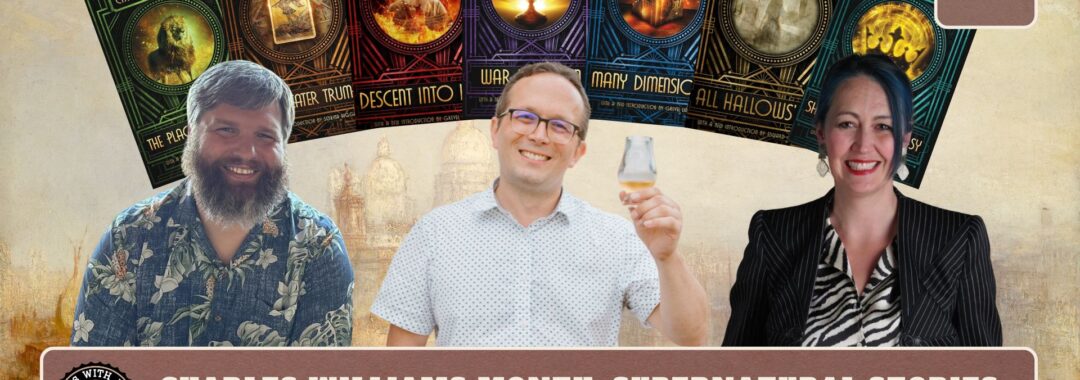
As part of Charles Williams Month we’re going to be taking a whistle-stop tour through the seven novels of Charles Williams with Dr. Sørina Higgins and Stephen Keck.
Click here to download audio for S9E24: “Supernatural Stories”
Show Notes
Quote-of-the-Week
I have just read your Place of the Lion and it is to me one of the major literary events of my life–comparable to my first discovery of George Macdonald, G. K. Chesterton, or Wm. Morris…
Letter from C. S. Lewis to Charles Williams (March 11th 1936)
Biography
Dr. Sørina Higgins is a Consulting Editor, author, English teacher, and award-winning scholar of British modernist literature. Her academic work focuses on the Inklings, modernism, and magic.
She’s a Consulting Editor and Writing Coach through Wyrdhoard and host of the Words Do Things podcast.
She previously edited an academic essay collection entitled The Inklings and King Arthur and is currently writing The Oddest Inkling: An Introduction to Charles Williams, due out from Apocryphile Press hopefully sometime this year…
She was first on Pints With Jack back in 2024 in a stand-alone episode about Charles Williams, and again more recently on a Half Pint episode to talk about the “Ideas Worth Saving” conference.
Stephen Keck who appeared on a Half Pint episode about a year ago with his sister, Jody. Jody and Stephen are the co-hosts of the Good Stories Podcast, a weekly show where they share their love of books, talking about a different book each week, which have included works by multiple inklings.
Chit Chat
Q. Sørina, what have you been up to since you were last on the show, aside from teaching my mother about Narnia?!
- Inklings Course from The Great Courses
- LWW Course
- Wyrdhoard: editing, teaching, YouTubing
- Words Do Things Podcast
Q. Stephen, as I mentioned in my introduction, you and your sister Jody have covered quite a few Inklings-related books on your show. What’s your favourite Lewis book? It’s not one of the usual ones you hear…
-Stephen’s favourite Lewis book at this time is The Discarded Image.
Toast
- David
- Since we’re discussing supernatural thrillers this week, I decided my drink had to be a spirit! In the end I chose a Suntory World Whisky called Ao. That’s spelt A-O. It’s Japanese for “deep blue”, a reference to the oceans which join the five different countries whose whiskies make this blend.
- Sørina
- Sørina enjoyed a red honeybush rooibos tea with maple syrup and hazlenut.
- Stephen
- Stephen was drinking a 90 Shilling Amber Ale in a Good Stories Podcast pint glass.
Discussion
01. “The Plan”
So today we’ll be discussing the seven novels of Charles Williams.
We’ll be addressing them in the order outlined by Sørina in her Reader’s Guide blog post hosted at The Oddest Inkling (link in the show notes).
We’re not going to go through each book in exactly the same level of detail, for the simple reason that this would take much longer than an hour’s episode, but also because I haven’t read them all!
The goal of this episode is to whet the appetite for people who haven’t read Williams, and give them some confidence and a framework for exploring his works… For each book, we’ll be asking…
- What is the central ritual object?
- What spiritual forces are invoked?
- What is the main conflict?
- What Christian elements are important?
- What esoteric elements are present?
02. “Our Histories”
Q. …but before we get to that, what have been your respective histories with these books?
Stephen discovered War in Heaven by Charles Williams in a literature class. Then, a few years ago read two more, which led to reading all of Williams, even the ones that made him profoundly uncomfortable.
Sørina read Williams because an undergraduate professor recommended him. She went on to read his Arthurian poetry and wanted to make her life work annotating it. She has had moments, like Stephen, of being disturbed by Williams, but keeps returning to him.
“I think the novels may be the best place for anyone to begin, simply because they are the easiest to read. That’s not to suggest that Williams’ novels are cheap page-turners: in the casual crowd of beach-novels, they stand alone in a corner, dressed in black, mysteriously murmuring big words, smoking artistic cigarettes. But at least they have fairly straight-forward plots, which cannot be said of his other works.” – Reader’s Guide
03. “Introducing Others”
Q. What do you think is the best way to pitch Williams in general and these books in particular to friends and family?
- [Sørina]
- There’s more to the world than meets the eye: the supernatural lurks everywhere, the paranormal could break in any time, and the heavenly touches the earthly at every corner
- In Williams’ universe, every detail of our lives has eternal significance
- [Stephen]
- In the letters of Tolkien during the war years, he references Charles Williams often and his love for him. This made Stephen wonder, “Who is this man who Tolkien loves, though he didn’t like all of his writings?” Lewis also loved Williams. T.S. Eliot also shared his love for Williams. If these giants whom he loves loved Williams, he thinks it’s worth giving Williams a try!
Q. If someone accepts your pitch to read Williams, are there any final words you’d offer before someone dives in for the first time?
- [Sørina]
- There is a bright glory that we get from Williams. Just enjoy the visual beauty and the tableaus.
- [Stephen]
- It’s a delight, just give it a try!
- [David]
- It’s a different kind of fantasy – Portal (Narnia), Immersive (LOTR), Invasive (Williams)
- Don’t expect to understand everything
It has always therefore been one of my main endeavours as a teacher to persuade the young that firsthand knowledge is not only more worth acquiring than secondhand knowledge, but is usually much easier and more delightful to acquire.
-C.S. Lewis in the preface to On the Incarnation
04. “Reading Order”
Sørina, in your Reader’s guide, you suggest the following order for reading William’s novels:
- War In Heaven
- Many Dimensions
- Place of the Lion
- The Greater Trumps
- Descent Into Hell
- All Hallows Eve
- Shadows of Ecstasy
Q. Broadly speaking, why do you arrange them in this order?
- [Sørina]
- This is the least difficult to most difficult in her opinion.
Q. Stephen, is there any alteration you’d make to this list? Any novels which you’d bring closer to the top or bottom of the list?
- [Stephen]
- Stephen would move The Greater Trumps down.
05. “Book #1 – War In Heaven”
Q. Since, out of all his novels, this book has the closest thing to a plot, what are the main story beats?
- [Stephen]
- This is a murder mystery about a corpse found at a London publishing company. It quickly moves into a country priest looking for the Holy Grail after reading an unpublished manuscript at said publishing house. There are multiple attacks on the Grail, ending with a battle between good and evil.
Q. What are some items of interest in the book?
This very cleverly humorous story takes two unlikely genres and brings them together, just to see what will happen. The murderer also confesses very quickly. There are ritual objects in each of Williams’ works which show us whether a character is moving closer to God or further away.
“And have you no fear,” said Ransom, “that it will ever be hard to turn your heart from the thing you wanted to the thing Maleldil sends?”
“I see,” said the Lady presently. “The wave you plunge into may be very swift and great. You may need all your force to swim into it. You mean, He might send me a good like that?” –Perelandra
- Christian elements
- God can care for himself, but he allows us to be a means of his grace
- Lots of Eucharistic associations with the Grail
- Sacramentality shines through
- Esoteric elements
- Black Mass
- Dark magicians who kill a character
- Occult try to wed a dead man’s soul to a living man’s body
- Grail is holding secret tradition
06. “Book #2 – Many Dimensions“
- The crown of Solomon is the ritual object
- Gives unlimited powers to the wearer
- The crown cannot be cut in half or diminished
- First time when time travel loops happen in a novel
The problem is that there are no limits. Not everyone can have everything they want. What is the end of desire? Williams let things truly get out of hand.
- Christian elements
- There are more Islamic elements
- Islamic characters talking about the unity of God
- This book is very Trinitarian
- Esoteric elements
- Doctrine of correspondence
- Crown and ring from Solomon – primal creative energy working through
- Kabbalah
You don’t know how bad it is [transportation in England]. Our motorways are shocking. -David Bates
07. “Book #3 – The Place of the Lion”
Next up we have The Place of the Lion, which Lewis fans will know chiefly because, after reading it in 1936, C. S. Lewis sent Williams a fan letter. I quoted a larger portion of this letter last week and quoted a smaller extract at the top of this episode. After receiving this letter from Lewis, the very next day Williams wrote back. He had just finished reading Lewis’ The Allegory of Love where he worked at Oxford University Press and replied:
My dear Mr Lewis, if you had delayed writing another 24 hours our letters would have crossed. It has never before happened to me to be admiring an author of a book while he at the same time was admiring me. My admiration for the staff work of the Omnipotence rises every day. -Charles Williams in a letter to Lewis
The Place of the Lion effectively got Williams a spot on the Inklings, so there’s got to be some good stuff here…
Q. First of all, what happens in The Place of the Lion?
- Lioness escapes from a traveling show
- Lion attacks someone, who is hospitalized
- There is work to restore the natural order as a bunch of animals break loose
- Even if you don’t know any of the ideologies, you can read this book!
- Christian elements
- when order is disrupted, what happens?
- What is God’s plan for man?
- brotherly friendship
- Esoteric elements
- programatic syncretism- every system of thought layered on top of each other
- primal archetypical forces
- idolatry of a scholarship
Williams uses this book to debut his thoughts which can be called Romantic Theology.
08. “Book #4 – The Greater Trumps”
Since we still have four more books to go before the end of the episode, with the possible exception of Descent into Hell, we’ll be going into a little less detail moving forward…
Q. What’s worth highlighting in The Greater Trumps?
-The central ritual objects were tarots cards and chess-like figurines. The main conflict is one character trying to steal these tarot cards from another and loosing a terrifying snowstorm that threatens to to devour the whole world. The saint goes out into the snowstorm to rescue someone and lives in the center of love as she does so and practicing perfect tranquility and the peace that passes understanding.
Submission and obedience come through strongly in this story, as well as the idea of a cosmic order to things. It’s a story about broken people who can be redeemed by love.
09. “Book #5 – Descent into Hell”
This is the work which contains all of the key Williams ideas. He started his own order, the Companions of the Co-Inherence, to practice his particular theological theology and practice.
There’s no central ritual object, but a play which all of the characters react differently to based on their heavenly or hellish trajectory.
His description of Hell is profound in this book, talking about the soul turning in on itself.
Incurvatus in se is a Latin phrase meaning “turned or curved inward on oneself”.
The references to The Tempest were ways of Williams to show himself a great playwright.
Q. Can we look at how some of these Williams ideas manifest in this book?
10. “Book #6 – All Hallows Eve”
Many critics claim that All Hallows Eve is Williams’ best novel.
- Masterfully done, bringing his ideology to maturity
- central ritual object is a painting
- art and act of creation
- marriage
Submission and obedience are prevalent again here. Faith over learning is also presented strongly. Williams also comments on poorly done magic. There was a character being raised on a cross, offering herself for someone else.
Q. Why do you think that is?
11. “Book #7 – Shadows of Ecstasy”
We saved the weirdest for last…
Q. Any thoughts or health warnings about Shadows of Ecstasy?
- High level magician trying to cheat death and is the villain
- A man who is enslaved by magic is saved by a very simple priest
- Williams imagines what would happen is Africans conquered Europe
12. “Adaptation?”
Q. As we begin to wrap up, do you think any of these novels could work in adaptation, either as a play or a movie?
- War in Heaven is being adapted right now by a screenwriter but The Greater Trumps would be beautifully done
Wrap Up
Concluding Thoughts
-Just enjoy the action and beautiful scenes. Don’t feel that you need to agree with everything or even the man himself, but just enjoy experiencing them.
More Information
- Good Stories Podcast, email Stephen at goodstoriespodcast@gmail.com
We’re going to add something to our usual sign-off today….
In Middle English romance and law, to “put oneself under another’s mercy” meant to yield oneself without conditions, abandoning claims of self-justification, accepting whatever judgment or pardon might be given.
While Williams did not coin the phrase, he made “go under the mercy” a central phrase in his worldview, using it to express his voluntary surrender, his renunciation of self-justification, as well as his theology of exchange and substitution… which we’ll talk about more next week! So please join us then as Charles Williams Month continues…
Support Us!
- Finally, if you’d like to support us and get fantastic gifts such as access to our Pints With Jack Slack channel and branded pint glasses, please join us on Patreon for as little as $2 a month.
- Subscribe to the audio feed on your preferred podcast platform, such as iTunes, Google Podcasts, Spotify, Audible, and many others…
- Follow us on Instagram, Facebook, YouTube, and Twitter
- See what we have planned for the rest of Season 9
- We would be grateful if new listeners would rate and review us on their preferred podcast platform.

Pingback: Charles Williams Month (April 2026) - Pints With Jack