
We wrap-up our time with The Abolition of Man by hosting a retrospective with Dr. Michael Ward, the author of After Humanity: A Guide to C.S. Lewis’s The Abolition of Man.
Click here to download audio for S9E22: “The Abolition of Man – Retrospective”
Show Notes
Quote-of-the-Week
You cannot go on ‘seeing through’ things for ever. The whole point of seeing through something is to see something through it. It is good that the window should be transparent, because the street or garden beyond it is opaque. How if you saw through the garden too? It is no use trying to ‘see through’ first principles. If you see through everything, then everything is transparent. But a wholly transparent world is an invisible world. To ‘see through’ all things is the same as not to see.
C. S. Lewis, The Abolition of Man (Chapter 3)
Introduction
For the past few months we’ve been walking through The Abolition of Man. Now that we’ve completed the whole book, we want to consider the work as a whole… and who better to be our guide than the man whose research we’ve been stealing from all season?! Former guest-of-the-show, author of After Humanity, Dr. Michael Ward…
Biographical Information
Dr. Michael Ward is an English literary critic and theologian, best known for his book Planet Narnia: The Seven Heavens in the Imagination of C.S. Lewis, in which he argues that The Chronicles of Narnia are structured to embody and express the imagery of the seven heavens of the medieval cosmos.
He has degrees from Oxford, Cambridge, and St. Andrews, and is currently Associate Member of the Faculty of Theology and Religion at the University of Oxford, Professor of Apologetics at Houston Christian University, Distinguished Visiting Professor of Hillsdale College in Michigan.
He’s been an extra in a number of films, including Shadowlands and The World Is Not Enough and even took the role of C.S. Lewis’s vicar in The Most Reluctant Convert.
Crucially for this season of Pints With Jack, he is the author of the 2021 book, After Humanity: A Guide to C.S. Lewis’s The Abolition of Man.
Chit Chat
Since he was last on the show, Dr. Ward contributed an essay on That Hideous Strength in Life on the Silent Planet: Essays on Christian Living from C.S. Lewis’s Ransom Trilogy. Dr. Ward draws a comparison between today’s chosen quotation and its fictional counterpoint from That Hideous Strength, quoting:
The workings, where Bragdon Wood had been, ceased to offend conservative eyes and became mere clangings, thuddings, hootings, shouts, curses, and metallic screams in an invisible world.
C. S. Lewis, That Hideous Strength (Chapter 2)
Both Dr. Ward and the hosts are hopeful and looking forward to Greta Gerwig’s upcoming film adaptation of The Magician’s Nephew.
Toast
- Dr. Ward had some Adam’s Ale(!)
- Andrew was drinking San Antonio Blend coffee
- Matt was drinking some decaf caramel coffee and Yerba Mate tea
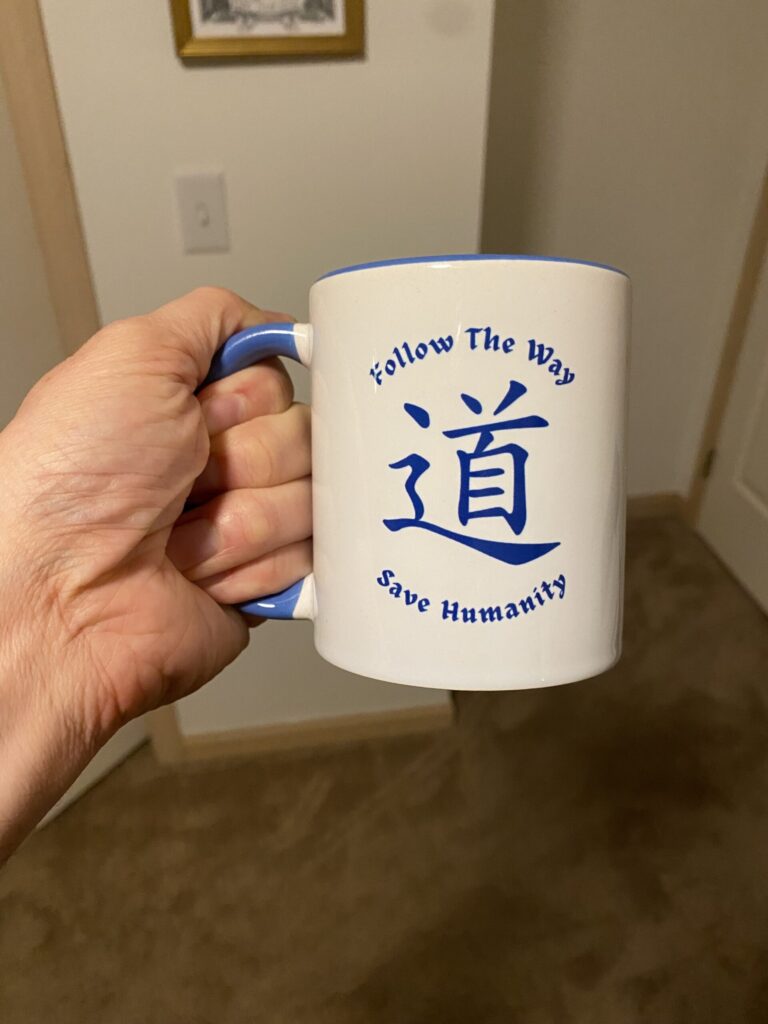
- David was drinking Yorkshire Gold tea from a mug he designed
They toasted new Patreon supporter, Mr. Jacob Moran of Ireland.
Discussion
01. “After Humanity”
Q. Let’s begin by talking about your book from which we’ve been liberally stealing, After Humanity… Would you mind telling listeners about it and how you came to write it?
Dr. Ward originally wrote After Humanity as an annotated edition to be published in one volume, but it was revoked because The Abolition of Man was not in the public domain. About 5 years later, Word on Fire happily took on the book and published it as two separate volumes, Dr. Ward’s work and a new edition of Abolition with a gorgeous matching cover.
02. “Second Edition?”
Q. It’s been a few years since you worked on After Humanity. I’m curious – is there anything you’d change if you were to produce a Second Edition?
Dr. Ward’s only desires for change were to have mentioned Plato more and to have not made a small error in misidentifying Paddy Moore in a photograph included in the book, which was fixed in subsequent printings.
03. “Prophecy”
The Abolition of Man is a highly prophetic book. He says that Lewis claimed that it is a work of ethics, not theology. It truly has spoken to generations because it does not just speak in one particular time. Lewis is not trying to find a solution or way out, but is showing where man will end up if he follows this course, that man truly will be abolished.
04. “Poetry”
A poem is something that is made with great rhetorical skill.
We make out of the quarrel with others, rhetoric, but of the quarrel with ourselves, poetry.
W. B. Yeats, Anima Hominis (Chapter 5)
Dr. Ward goes on to say that Lewis is quarrelling in this book with himself about objective value finding himself on the side of objective value and not subjectivism. There is poetic imagery throughout the entire book.
05. “Participation”
Lewis is not merely laying out a set of ideas, but talking about living or failing to live a moral life. You must behave morally and not just think about behaving morally in order to properly participate fully. Andrew then draws into the discussion the connections to Mere Christianity, when Lewis outlines this very necessity of acting in morality and not simply proclaiming it. Lewis never asked people to do what he was not himself prepared to enact.
06. “Power”
Sometimes the right thing to do will involve powerlessness. Sometimes doing the right thing will reduce you or cost you your life. As Lewis quotes, “Dulce et decorum est pro patria mori” – “It is sweet and fitting to die for one’s country.”
07. “Green Book motivations”
Q. In your research for After Humanity, did you come across anything which could answer the question about the motives behind The Green Book? Were they consciously trying to teach philosophy? Did wartime propaganda make them disillusioned about truth claims?
Dr. Ward doubted that war propaganda had anything to do with it and doesn’t think they consciously attempting to teach philosophy. Lewis is just using the book as a springboard to make his argument.
08. “Above and below”
Q. In Chapter 1, Lewis says we can be immune to manipulation through adverts by being “above” or “below” the advertisement. We spent a bit of time trying to tease out exactly what that means and what it would look like. How would you explain it?
“There are two men to whom we offer in vain a false leading article on patriotism and honour: one is the coward, the other is the honourable and patriotic man. None of this is brought before the schoolboy’s mind.”
C. S. Lewis, The Abolition of Man (Chapter 1)
09. “Reason & Practical Reason”
Q. In Chapter 2, Lewis says that someone might try and ground an alternative set of values in “Reason”. During our discussions, I don’t think we really dug into the distinction Lewis makes between “Reason” and what he calls “Practical Reason”. Would you mind explaining the difference?
Lewis says that, “To lead a civilized life on reason alone…” does not work and leads to difficulties. Practical reason involves emotions. The passions and reason work in tandem.
10. “Abolition and the Inklings”
Q. Do we know how Abolition was influenced by and received by the Inklings? Owen Barfield seemed to be a fan…
Owen Barfield did indeed speak very warmly about it, but Dr. Ward didn’t know how the rest of the Inklings received it.
Wrap Up
Closing Thoughts
Q. Any closing thoughts about The Abolition of Man?
The Abolition of Man is the main frame of Lewis’ thinking because it establishes his belief in objective value. That Hideous Strength is the fictional companion to it and Dr. Ward gives several examples to expound on this.
Dr. Ward speaks about the importance of the imagery of waterfalls for Lewis in many of his works, particularly The Great Divorce. Lewis thought the waterfall was a beautiful image of pouring oneself out and embracing that powerlessness discussed earlier.
More Information
Support Us!
- If you’ve enjoyed this episode, why not send us an Abolition-inspired Haiku? We have a copy of Dr. Ward’s book and accompanying copy of The Abolition of Man to be given away to our favourite!
- Subscribe to the audio feed on your preferred podcast platform, such as iTunes, Google Podcasts, Spotify, Audible, and many others…
- Follow us on Instagram, Facebook, YouTube, and Twitter
- See what we have planned for the rest of Season 9
- We would be grateful if new listeners would rate and review us on their preferred podcast platform.
- Finally, if you’d like to support us and get fantastic gifts such as access to our Pints With Jack Slack channel and branded pint glasses, please join us on Patreon for as little as $2 a month.



Excellent, as always!
My haiku
No Dao to follow
Smitten by novel technique
Lost men without chests
Merci!
Haiku
Abolition of Man
Dulce et decorum est
know not Hollow Men.
Virtue requires Love
for good measure, another for That Hideous Strength:
Blind without the Light
Male and female separate.
Heavens join Terra
Water falls, sublime.
Mankind is poured out in Love.
We gain what we lose.