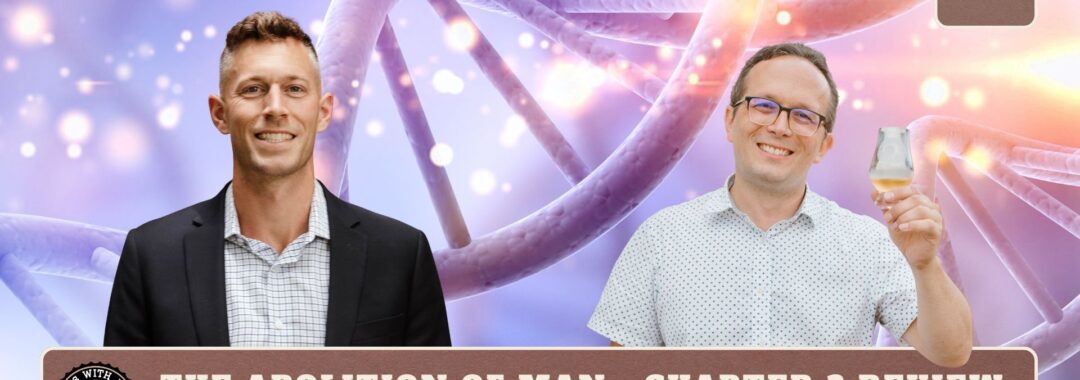
As we near the end of “The Abolition of Man”, Joseph Weigel joins David to review the book’s final chapter.
Click here to download audio for S9E21: “The Abolition of Man – Chapter 3 Review”
Show Notes
Quote-of-the-Week
I have described as a ‘magician’s bargain’ that process whereby man surrenders object after object, and finally himself, to Nature in return for power. And I meant what I said.
C. S. Lewis, The Abolition of Man (Chapter 3)
Introduction
Welcome friends to Pints With Jack! This month we’ve completed the reading of Chapter 3 of “The Abolition of Man”. As Andrew, Matt, and David have been reading, we’ve concluded each chapter with a review episode where David interviews a special guest, reviewing each chapter as a whole, and today talking with him about Chapter 3 is Joseph Weigel.
Biographical Information
Joseph Weigel is a husband, father, and host of the Men with Chests podcast. He is the author of articles which can be found in Sehnsucht and VII, and he is the author of the upcoming book from Apocryphile Press, “Planet Thulcandra: Magic and Science in C. S. Lewis’s That Hideous Strength”.
Chit Chat
- David thought Mr. Weigel ahd been interviewed on this show before, but as he was preparing my notes, he realized that he was a panelist on #CSLewisReadingDay and David appeared on his podcast to talk about “The Great Divorce”, but that’s it! So, needless to say, this episode is long overdue!
Toast
- David was enjoying a nice glass of Aberfeldy.
- Mr. Weigel had a glass of bourbon whiskey from Heaven Hill Distillery.
- We’ve got a few Patreon supporters to toast today… Benton Schmidt, as well as Robbie and Bruce Hinshelwood… We hope you’ve all been enjoying our discussion this season and pray that this study will bear fruit in your lives and help prevent the abolition of man… Cheers!
Discussion
01. “Personal History”
Q. So Joseph, what’s your own history with The Abolition of Man?
- Interested in reading philosophy, he learned that Abolition was one of the great works of the 20th century, and decided to pick it up. He was familiar with lewis from the Narnia series as a child and had read “Mere Christianity” as an adult, but never studied his corpus. But Abolition hooked him with its depth and complexity, and he decided to do a deeper dive on the author after.
02. “The Argument of Chapter Three”
Q. What would you say is the core argument to Chapter 3?
- The most concise summary is that “subjectivism is leading to man’s attempt to create a post-human world, where the wants of the Conditioners replace the Tao (Natural Law).” Let’s examine this closer:
- Man is attempting to take complete control of human nature. There’s two things that make this control possible:
- The omni-competent state + technology
- Rejection of the Tao
- Lewis goes on to say that when subjectivism “debunks” the inherent, objective goodness of things, all that is left is your personal feelings and wants. More specifically, all that matters is the whims of the Conditioners.
- This cuts out anything that is immaterial.
- Jack thinks that this will lead to the surrendering of our souls and humanity, which is the final step in our conquest of nature, and subsequently, our downfall.
- Man is attempting to take complete control of human nature. There’s two things that make this control possible:
- This phenomenon is taking place everywhere. Democracy is not immune to it; it’s just as present there as in totalitarian regimes.
- At the end, Lewis proposes a cure or a preventative measure for man’s abolition, which is “regenerate science”.
03. “Man’s Conquest of Nature”
Q. This opens with a discussion of “Man’s conquest of nature”. Why do you think Lewis spends so much time on this?
- To quote the prophet Lewis:
I am only making clear what Man’s conquest of Nature really means and especially that final stage in the conquest, which, perhaps, is not far off.
C. S. Lewis, The Abolition of Man (The Abolition of Man)
- What he’s getting at here is that there will be a few men with insubordinate power over the rest. They will have conquered human nature, but in doing so, they will have killed human consciousness and perception of the Tao.
- This will form a new “human” nature, but by getting rid of this essential part of ourselves, we cease to be men at all. Hence, the abolition of man.
Q. Why do you think he picks the examples he does? The Plane, radio, and contraception? Do you think he (or would you) pick different examples today?
- These things were very relevant in Lewis’s time, something people could deeply resonate with. The plane and the radio were prominent features in the WWII time period, and the contraceptive was becoming socially acceptable, available, and popular, despite its not-so-subtle ties to eugenics pre-WWII. It was also a hot-button issue in the Anglican church.
- Mr. Weigel gave three modern examples along the similar vein of transportation, communication, and reproduction:
- Self-driving cars: while making things convenient, you are dependent on it being right in its calculations.
- Social media: for obvious reasons. It is frequently used to promote propaganda.
- Abortion: you have the power of life or death over a child in the womb.
04. “Generations Over Time”
Q. Would you talk to us a little bit about how Lewis sees subsequent generations affecting each other, and his great fear?
- Humans pass on traits, habits, practices and traditions to the next generation. But what happens when one generation is not taught the Tao? They lose their humanity. And if they loose their humanity, they can’t pass on humanity to younger people.
Q. How will this “master generation” operate once they are free from the Tao?
- All you have left is what you want! Your impulses will shape things. It becomes like the old Latin phrase “sic volo, sic jubeo”, or “I will, and thus I command”.
- Lewis debunked every other explanation the Conditioners might give, so he suspects that they will ultimately throw up their hands and embrace this purely impulse-based justification to stay consistent with their philosophy.
05. “Scaremongering”
Q. Is Lewis just scaremongering about a nightmare future where evil men gain the reigns of power?
- He might have been engaging in that a bit. It would be rather difficult to fully remove all of humanity.
- It would either have to be done through brutal force, a dissolving of all borders to create a world state, or through total control of reproduction (as depicted in “That Hideous Strength”, or the movie Gattaca).
- However, it doesn’t take away from his warning. Even attempting to do this project could damage many souls and the generations after them.
- Think about the COVID-19 example. Whatever your thoughts are on it, one thing we can all agree on is that humanity’s response was a very mixed bag.
06. “Own Goal”
Q. Why does Lewis think it’ll end in an “own goal” as we say in English football? Why is it that when we come to master our own nature we’ll eradicate it?
- For the Conditioners to have control of our conscience is to not be conscious. Human beings require freedom of will and a sense of right and wrong. We will be more like robots than humans.
Q. What do you make of CSL’s suggestion that the conditioners would come to hate their subjects?
- If you want to love someone or something, act like you do, and the feelings will come.
- In “Mere Christianity”, Lewis gives the example of the Nazis treating the Jews badly, and coming to hate them more because of their behavior towards them.
The Germans, perhaps, at first ill-treated the Jews because they hated them: afterwards they hated them much more because they had ill-treated them.
C. S. Lewis, Mere Christianity (Forgiveness)
- Mr. Weigel believes that the subjects would retain some sort of objective meaning, and the Conditioners would subsequently become jealous of their patient’s sense of purpose and objectivity.
- We don’t even have to be a Conditioner to be existentialist. If God is out of the picture in your life, meaning and purpose is, at best, self-created.
07. “What Even Is Nature?”
Q. Jack reexpresses his argument talking about what we even mean when we speak about “nature”. What’s he doing here?
- Jack is trying to make clear that the abolition of man means controlling the human soul to the point where its perception of free will, creativity, and the natural law are gone. It’s the removal of the “Imago Dei”, turning us into mere nature.
- Lewis makes this point in other works, including his fiction, such as in “The Voyage of the Dawn Treader”. Things aren’t just the sum of their parts.
“In our world,” said Eustace, “a star is a huge ball of flaming gas.”
C. S. Lewis, The Voyage of the Dawn Treader
“Even in your world, my son, that is not what a star is, but only what it is made of.”
08. “Science and Magic”
Q. A good part of Chapter 3 is about the relationship between science and magic. Would you mind talking us through how Lewis views these disciplines?
- A few definitions for how Lewis is using these words in “Abolition”:
- Science: the applied physical or material sciences, not simply knowledge.
- Magic: the attempt to use spirits (of different sorts) to command persons and things.
- In “Abolition”, he describes the connections between the two, and unveils their unifying feature, which is power by any means necessary.
- He goes into much further detail about this topic in “That Hideous Strength”, where magic is explicitly condemned, true science is defended, and social science is pilloried. He also implies that this quest for power and immortality is demonic.
Q. While we’re on the subject of science and magic, please tell us a bit more about your book coming out later this year…
- The book is “Planet Thulcandra”. It goes through “That Hideous Strength” chapter by chapter, discussing the relevant topics of magic and science, along with Lewis’s views on the spiritual realm, politics, and education.
- Essentially, it’s a book that helps people understand the final novel in the Ransom trilogy, because many people are very confused about how we can go from university meetings to planetary invasions, Merlin, and scientists essentially communicating with demons.

09. “That Hideous Strength”
Q. We’ll be going through That Hideous Strength next season. What are some of the themes from Abolition, particularly this chapter, which we’ll be encountering again there?
- The biggest theme is the attempt to create a post-human world. Essentially, Lewis wrote a fiction book that was further exposition of his lectures.
- Further themes include the relationship between science and magic, language, and education driving our abolition.
10. “Science’s Cure”
Q. Lewis suggests that the “cure”, or rather prevention of the abolition of man may come from science. I think some of his language (“Natural Philosophy”) and references (“Geothe”, “Dr. Steiner”) obscure his point somewhat… what’s his suggestion?
- He’s again pointing to a tendency on the part of the Conditioners to reduce everything to mere matter.
- Lewis probably wouldn’t go as far as Geothe and Steiner and include a spiritual component to science.
- “Regenerate science” (or “purified”, “science with a soul”) depends on first principles to operate. We need to believe that inductive reasoning is trustworthy, and bring us to truth, rather than just survivability.
- In Lewis’s book “Miracles” (terrible name for what the book’s about), he talks about the self-defeating nature of naturalism. If our cognitive faculties were brought about purely for survival purposes, we can’t have any reassurance that they’ll bring us to truth.
- These first principles also give us ethical boundaries that make science stay within its lane. Without boundaries, science becomes dangerous, frightening, and disordered.
- One example of a scientist that follows regenerate science is MacPhee in “That Hideous Strength”. While he is more of a materialist, he isn’t okay with the pseudoscience the other experts are engaging in, because we was raised within an ethical framework.
[I would have] sooner play cards against a man who was quite sceptical about ethics, but bred to believe that ‘a gentleman does not cheat’, than against an irreproachable moral philosopher who had been brought up among sharpers.
C. S. Lewis, The Abolition of Man
10. “Practical Application”
Q. What do you think are the practical applications of this chapter?
- We need to recognize the first principles regenerative science operates from, and understand that science is not the end-all-be-all.
- It also shows our need for a re-enchantment of the world beyond the material.
- In this though, we need to make sure our re-enchantment is ethical, not the dark version that is beginning to draw people today.
- Finally, this book highlighted the impact that education can have on us, where we are going wrong, and what we should do:
For the wise men of old the cardinal problem had been how to conform the soul to reality, and the solution had been knowledge, self-discipline, and virtue.
C. S. Lewis, The Abolition of Man
- One line that stuck out to David in this chapter related to science, when Lewis said “perhaps it had moved too quickly”. Maybe we should exercise more caution in our pursuit of progress and developments.
Wrap Up
Closing Thoughts
- Mr. Weigel offered some essays that would be good reading before next season:
- “The Poison of Subjectivism”
- “On Ethics”
- “Is Progress Possible?” (otherwise titled “Willing Slaves of the Welfare State”)
- “A Reply to Professor Haldane” (contains some plot spoilers)
- But if anyone’s scared of this book with all the prep work we’re suggesting, fear not! This book is deep and wild, but it’s a blast.
More Information
–
Support Us!
- Subscribe to the audio feed on your preferred podcast platform, such as iTunes, Google Podcasts, Spotify, Audible, and many others…
- Follow us on Instagram, Facebook, YouTube, and Twitter
- See what we have planned for the rest of Season 9
- We would be grateful if new listeners would rate and review us on their preferred podcast platform.
- Finally, if you’d like to support us and get fantastic gifts such as access to our Pints With Jack Slack channel and branded pint glasses, please join us on Patreon for as little as $2 a month.