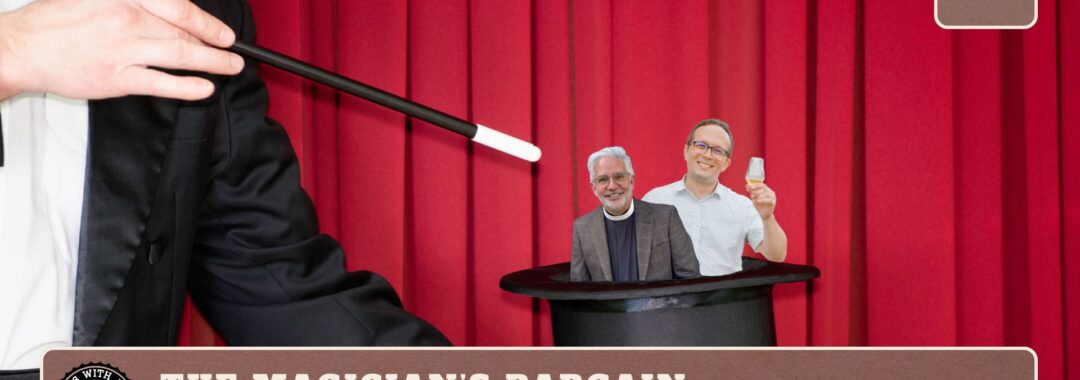
Matt leaves Andrew and David to wrap up the final part of The Abolition of Man where Lewis talks about “The Magician’s Bargain”.
Click here to download S9E20: Abolition – Ch. 3, Pt. 3 (“The Magician’s Bargain”)
Show Notes
Quote-of-the-week
You will even find people who write about the sixteenth century as if Magic were a medieval survival and Science the new thing that came in to sweep it away. Those who have studied the period know better. There was very little magic in the Middle Ages: the sixteenth and seventeenth centuries are the high noon of magic. The serious magical endeavour and the serious scientific endeavour are twins: one was sickly and died, the other strong and throve. But they were twins. They were born of the same impulse.
C. S. Lewis, The Abolition of Man (The Abolition of Man)
Introduction
Welcome friends to Pints With Jack! As we were wrapping up the last episode, Matt dropped off to take his wife to the hospital as her contractions were starting to pick up… so I’m guessing you’d like to know how that ended?
Well, when they got to the hospital, they learned it was a false alarm, so they went home. But they went back a few days later, and… habemus infantem! Her name is Sienna Marie (clearly inspired by David: his wife’s name is Marie, and they own a green Sienna).
Chit Chat
- Matt is at home today, looking after Mary-Margaret and his newborn daughter. We expect for him to be quite distracted for the meantime.
Toast
- Q. Andrew, can you please toast our new little shrub?
Discussion
Recap
- The book begins with Lewis arguing against subjectivism, contrasting it with a doctrine of objective value which he says we must presuppose. He calls this “the Tao”.
- While critics may attempt to define a system of values outside of the Tao (based on Utilitarianism, Reason, or Instinct), Jack shows they all fail and are simply cherry-picking from the Tao without justification.
- He says that alternatively, rather than attempting to ground a different system of values, critics may abandon “value” entirely, simply shaping humanity as they see fit without even trying to justify it.
- We began Chapter 3 this month pondering the phrase “Man’s conquest of nature”…
- After considering the aeroplane, the wireless, and the contraceptive, Lewis concludes that “Man’s conquest of nature” is simply the accumulation of power by some men over others.
- Lewis asks us to consider humanity throughout time, with each generation attempting to
- (a) limit the power of its predecessors and (b) exercise its own power over its successors.
- Up until now, a generation’s ability to do this has been somewhat limited.
- However, Lewis warns us of a future where eugenics, prenatal conditioning, and applied psychology will allow one singular generation to shape the rest of humanity for all time.
- If these men operate outside of the Tao, where the words such as “good” and “bad” have no meaning, how will they choose to shape us?
- Well, deprived of the Tao, the Conditioners will do this based on their natural impulses
- Ironically, this means that as man thinks he’s conquering Nature, Nature will have actually conquered man!
- Human beings will have become objects, artifacts to be manipulated.
- The Conditioners will force their will on their subjects and Jack suggests that they may come to hate their subjects, envying the illusion of whatever artificial conscience they choose impart to them.
- Well, deprived of the Tao, the Conditioners will do this based on their natural impulses
- Jack then reexpresses his argument, showing how “nature” is just what we call something when we reduce it to its parts and manage to exert control over it.
- In fact, he says we reduce things to mere “Nature” in order that we may “conquer” them and when we do this, we lose something of it.
- Once again he warns of a final step from which, when taken, we may never recover…
- … reducing our own species to “nature” and lose something essential to our humanity…
- …and in the final section we read today, we’ll further explore this “magician’s bargain”…
01. “Having it Both Ways”
Q. Lewis says that humanity has been trying to be like Shakepeare’s King Lear – why?
- King Lear gave his kingdom to his daughters but retained a large number of knights for himself as though he were still monarch.
- As humanity we’ve been trying to have it all:
- “…lay down our human prerogative and yet at the same time to retain it”
- He says we have to make a choice…
- “Either we are rational spirit obliged for ever to obey the absolute values of the Tao, or else we are mere nature to be kneaded and cut into new shapes for the pleasures of masters who must, by hypothesis, have no motive but their own ‘natural’ impulses”
Q. Why does Jack think the Tao our only option?
- It’s the only thing which can create a framework for society:
- Only the Tao provides a common human law of action which can over-arch rulers and ruled alike. A dogmatic [“good”/”true”/”fitting”] belief in objective value is necessary to the very idea of a rule which is not tyranny or an obedience which is not slavery.
- See Lewis’ essay, The Humanitarian Theory of Punishment.
02. “Devils are Unmaking Language”
Q. Who is liable to bring about this tyranny?
- Practically anyone!
- He says he’s not thinking “not here thinking solely, perhaps not even chiefly, of those who are our public enemies at the moment”
- Hitler?
- He says that The process which… will abolish Man goes on apace among Communists and Democrats no less than among Fascists
- While the danger from more obvious extremist regimes (Communist, Fascist), Lewis warns us that this abolition can come about through those far more mild-mannered:
- “…many a mild-eyed scientist in pince-nez, many a popular dramatist, many an amateur philosopher in our midst, means in the long run just the same as the present rulers of Germany”
- A bold move in WWII!
Screwtape anyone?
https://en.wikipedia.org/wiki/Eichmann_in_Jerusalem
Q. Jack then gives a great one-line summary of this whole book: “Traditional values are to be ‘debunked’ and mankind to be cut out into some fresh shape at the will (which must, by hypothesis, be an arbitrary will) of some few lucky people in one lucky generation which has learned how to do it. The belief that we can invent ‘ideologies’ at pleasure, and the consequent treatment of mankind as mere ὕλη, specimens, preparations, begins to affect our very language” I’m sure Andrew has something to say about this change in language…
- https://allpoetry.com/Re-adjustment
- Jack shows how language has changed in our own age:
- “killed bad men” → “liquidate unsocial elements”
- “Virtue” → “integration”
- “Diligence” → “dynamism”
- “boys likely to be worthy of a commission” → “potential officer material”
- “virtues of thrift and temperance, and even of ordinary intelligence” → “sales-resistance”
- Owen Barfield wrote this in Poetic Diction:
- “Of all devices for dragooning [coercing] the human spirit, the least clumsy is to procure its abortion in the womb of language..”
Q. Lewis says that the insidious nature of what is going on has been concealed by abstraction. What does he mean?
- He’s talking about the abstraction, “Man”
- It has a meaning from within the Tao
- “In the Tao itself, as long as we remain within it, we find the concrete reality in which to participate is to be truly human: the real common will and common reason of humanity, alive, and growing like a tree, and branching out, as the situation varies, into ever new beauties and dignities of application”
- Lewis began this chapter about “Man’s conquest of nature”. Here he says that, as long as we’re in the Tao we talk about Man having power over himself in a similar way we can talk about an individual’s self-control.
- However, as soon as we step outside of the Tao, that disappears, and “Man’s power over himself” now refers to the rule of the Conditioners of the others, the “conditioned human material”.
- It has a meaning from within the Tao
03. “Anti-Science?”
Q. Jack says that some people will inevitably say he’s anti-science and an obscurist who’s just trying to prevent the growth of knowledge. How does he defend himself?
- He says that “real Natural Philosophers” will know that this isn’t fair since they’ll know that, as he defends objective value he is, among other things, defending the value of knowledge because with objective value it disappears too…
- He also defends himself against the charges of being anti-science by saying that Science itself might provide the safeguard against this abolition of man.
04. “Magic & Science”
Q. Before Lewis explains how science itself might hold the cure, it first of all spends some time talking about magic. Why’s he talking about magic?
- He says…
- “I have described as a ‘magician’s bargain’ that process whereby man surrenders object after object, and finally himself, to Nature in return for power. And I meant what I said.”
- He says that people misunderstood the relationship between science and magic.
- “You will even find people who write about the sixteenth century as if Magic were a medieval survival and Science the new thing that came in to sweep it away. Those who have studied the period know better. There was very little magic in the Middle Ages [5th-15th Century]: the sixteenth and seventeenth centuries are the high noon of magic. The serious magical endeavour and the serious scientific endeavour are twins: one was sickly and died, the other strong and throve. But they were twins. They were born of the same impulse.”
- He says that prior to this…
- “For the wise men of old the cardinal problem had been how to conform the soul to reality, and the solution had been knowledge, self-discipline, and virtue.”
- Whereas afterwards a different plan was formulated:
- “For magic and applied science alike the problem is how to subdue reality to the wishes of men: the solution is a technique; and both, in the practice of this technique, are ready to do things hitherto regarded as disgusting and impious—such as digging up and mutilating the dead”
- To drive home his point, he compares Francis Bacon and Marlowe’s Faustus
- “The true object is to extend Man’s power to the performance of all things possible. He rejects magic because it does not work; but his goal is that of the magician.”
- Paracelsus was both scientist and magician
- “For magic and applied science alike the problem is how to subdue reality to the wishes of men: the solution is a technique; and both, in the practice of this technique, are ready to do things hitherto regarded as disgusting and impious—such as digging up and mutilating the dead”
- He says that the effectiveness of science led it to prosper, but the negative elements shape its trajectory:
- “No doubt those who really founded modern science were usually those whose love of truth exceeded their love of power; in every mixed movement the efficacy comes from the good elements not from the bad. But the presence of the bad elements is not irrelevant to the direction the efficacy takes. It might be going too far to say that the modern scientific movement was tainted from its birth: but I think it would be true to say that it was born in an unhealthy neighbourhood and at an inauspicious hour. Its triumphs may have been too rapid and purchased at too high a price: reconsideration, and something like repentance, may be required.”
- Very sad Matt isn’t here… David Copperfield
05. “The Scientific Cure?”
Q. So, given everything he’s said about magic and science, why might he imagine that science could possibly be the preventative measure against the abolition of man?
- Lewis wonders if a new “Natural Philosophy” could arise.
- This term is interesting since it’s the pre-19th Century term used to describe science and its different subdisciplines
- Could this be because it was a term when thinkers weren’t so reductive?
- “Is it, then, possible to imagine a new Natural Philosophy, continually conscious that the ‘natural object’ produced by analysis and abstraction is not reality but only a view, and always correcting the abstraction?”
- He names two men who possibly might have an approach which would fulfil this:
- Goethe
- He also wrote his own version of Faust
- Lewis doesn’t seem to have dug into it.
- Dr. Ruolf Steiner (Anthroposophist)
- Lewis knew via Owen Barfield
- Neither of these men were materialists. They saw nature as more than mere matter.
- He refers to German Jewish theologian Martin Buber
- Thou should not become It
- Goethe
Q. What would be some characteristics of this new Natural Philosophy?
- Care and respect for what is studied
- “The regenerate science which I have in mind would not do even to minerals and vegetables what modern science threatens to do to man himself.”
- Not reductive
- “When it explained it would not explain away. When it spoke of the parts it would remember the whole… Its followers would not be free with the words only and merely“
- Wouldn’t abolish man!
- “In a word, it would conquer Nature without being at the same time conquered by her and buy knowledge at a lower cost than that of life.”
06. “Asking the Impossible?”
Q. Lewis ends on a note rather lacking in hope… In speaking about this new Natural Philosophy, he may be asking for something impossible. “Perhaps, in the nature of things, analytical understanding must always be a basilisk which kills what it sees and only sees by killing” What does he mean?
- Basilisk was a legendary reptile reputed to be a serpent king, who causes death to those who look into its eyes.
- Cf Harry Potter
- The point is that to do science might just mean this is inevitable.
- He says that if scientists aren’t going to stop it, someone else will have to. However, he’s afraid his warnings will just be dismissed.
- There are some steps that cross a line and mark a point of no return.
- “There are progressions in which the last step is sui generis—incommensurable with the others—and in which to go the whole way is to undo all the labour of your previous journey.”
- There are some steps that cross a line and mark a point of no return.
Q. What’s the final step regarding the Tao which might be the point of no return?
- Reducing it to mere nature:
- “To reduce the Tao to a mere natural product is a step of that kind. Up to that point, the kind of explanation which explains things away may give us something, though at a heavy cost. But you cannot go on ‘explaining away’ for ever: you will find that you have explained explanation itself away. You cannot go on ‘seeing through’ things for ever. The whole point of seeing through something is to see something through it. It is good that the window should be transparent, because the street or garden beyond it is opaque. How if you saw through the garden too? It is no use trying to ‘see through’ first principles. If you see through everything, then everything is transparent. But a wholly transparent world is an invisible world. To ‘see through’ all things is the same as not to see.”
- The Country of the Blind
Wrap Up
Closing Thoughts
–
Support Us!
- Subscribe to the audio feed on your preferred podcast platform, such as iTunes, Google Podcasts, Spotify, Audible, and many others…
- Follow us on Instagram, Facebook, YouTube, and Twitter
- See what we have planned for the rest of Season 9
- We would be grateful if new listeners would rate and review us on their preferred podcast platform.
- Finally, if you’d like to support us and get fantastic gifts such as access to our Pints With Jack Slack channel and branded pint glasses, please join us on Patreon for as little as $2 a month.
