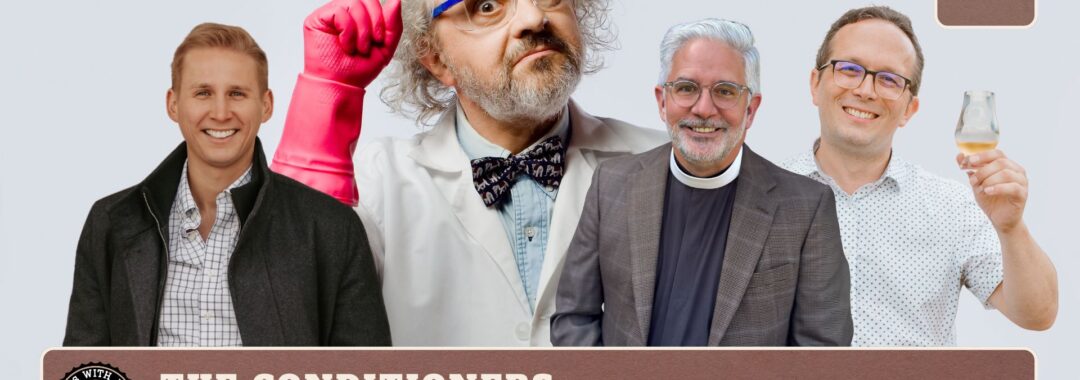
Who are the Conditioners and why should we fear them? Matt is back, but does he have a baby with him? All these questions answered in today’s episode!
Click here to download audio for S9E19: “The Abolition of Man – Chapter 3, Part 2”
Show Notes
Quote-of-the-Week
It is not that they are bad men. They are not men at all. Stepping outside the Tao, they have stepped into the void. Nor are their subjects necessarily unhappy men. They are not men at all: they are artefacts. Man’s final conquest has proved to be the abolition of Man.
C. S. Lewis, The Abolition of Man (The Abolition of Man)
Introduction
Welcome friends to Pints With Jack! Last week we began Chapter 3 of “The Abolition of Man”… Today we will continue with this chapter and then wrap it up next week!You will recall that last week that we were without Matt as he had gone into the hospital, supposedly to have a child… What happened?!
Chit Chat
- No baby yet for Matt! But quite possibly today?
- David and his team at work finally finished up their big project deadline and a rewrite of their Canva app, so he’s very much looking forward to getting some rest and recuperation before his next round of projects begin!
- Andrew has been busy too, with a requiem celebration on Sunday, and his treatise defense on Saturday. He’ll hear about the decision on his treatise on February 4th, and there is a doctoral ceremony on February 10th. By the time the celebrations are complete, he’ll be about halfway through the drafting of his book with Dr. Diana Glyer on “Till We Have Faces”.
- In Ransom’s intellectual battle with the Un-Man, it began with reason and wit, but it ended with boxing, so David helpfully reminded Andrew to bob his head and be on the lookout for a right hook!
Toast
- David had a Suntory World Whiskey called Ao (pronounced “ow”), along with a large cup of tea.
- Andrew drank an Old Speckled Hen out of his PWJ glass.
- Matt was having Best Day Brewing’s Galaxy Ripple Imperial IPA.
- Today we’re toasting our new Patreon supporter, Ryan!
Discussion
Recap
- In Chapter 1, Lewis argues against subjectivism and instead argues for a doctrine of objective value, which he calls “the Tao”.
- At the start of Chapter 2, he considers various attempts to justify a system of values outside of the Tao. He considers Utilitarianism, Reason, Instinct… and they all fail.
- While Jack believes that organic development can take place within the Tao, he doesn’t think it can be surgically changed from the outside…
- He claims that if we do not take the principles of the Tao as our starting premises, it would be logically inconsistent to cherry-pick elements of it…
- …therefore, rather than attempting to justify a different system of values, opponents to the Tao might abandon “value” entirely, choosing instead to shape mankind simply according to their own wishes, which is explored further in Chapter 3…
- The final chapter begins with a consideration of the phrase “Man’s conquest of nature”.
- Using the examples of the aeroplane, the wireless, and the contraceptive, Lewis argues that what we call “Man’s power” is, in reality, a power possessed by some men which they may (or may not) allow other men to use.
- Contraception is unique among his examples in that all possible future generations are the subjects of this power, since those already alive can choose to deny those possible future generations existence.
- Lewis takes pains to point out that he’s not talking about abuses of power, but simply what “Man’s conquest of nature” really means…
- He then asks us to consider humanity throughout time, where each generation may choose to limit the power of its predecessors and exercise its own power over its successors.
- This is done by modifying the environment bequeathed to them and rebelling against the tradition passed down to them.
- Lewis notes that prominent figures have always tried to shape future generations (he gives the examples of Plato, Elyot and Locke), but he warns that one day there may come a generation which will dominate all subsequent ages since they…
- …are using new technological power, such as eugenics, pre-natal conditioning, and perfectly applied psychology to shape the future generations…
- …and this master generation may be operating outside of the Tao, shaping humanity as they see fit.
- Jack points out that this power will not even be wielded by all men of that generation, but a small subset whom Lewis calls “The Conditioners”.
- Thus we see that “Man’s conquest of Nature”, may ultimately mean the rule of a few hundred men over billions…
- …and Jack continues to explore this dystopian nightmare as we enter Part 2…
- Using the examples of the aeroplane, the wireless, and the contraceptive, Lewis argues that what we call “Man’s power” is, in reality, a power possessed by some men which they may (or may not) allow other men to use.
01. “What Kind of Artificial Tao?”
Q. Lewis begins this section of the chapter by considering the Conditioners, those who will be shaping the Human race according to their wishes. He says they’re going to choose their own “artificial Tao”, creating the motives for future generations. However, Lewis asks “How are they going to be motivated?” What does he answer?
- He suggests that traces of the “old ‘natural’ Tao” might survive in their minds. Running off the fumes of the previous generation, they may still conceive of themselves as guardians of humanity with “a ‘duty’ to do it ‘good’”…
- …but what do they mean by “duty”, and what do they mean by “good”? It will soon occur to them that they only have these notions because of social and natural processes upon them which they themselves now control!
- In other words, they arrive back at the Tao.
- So the question now is whether they choose to leave such notions in place.
Duty itself is up for trial: it cannot also be the judge. And ‘good’ fares no better. They know quite well how to produce a dozen different conceptions of good in us. The question is which, if any, they should produce. No conception of good can help them to decide. It is absurd to fix on one of the things they are comparing and make it the standard of comparison.
C. S. Lewis, The Abolition of Man (The Abolition of Man)
- This is an argument he develops in “Mere Christianity”. Lewis writes:
Supposing you hear a cry for help from a man in danger. You will probably feel two desires – one a desire to give help (due to your herd instinct), the other a desire to keep out of danger (due to the instinct for self-preservation). But you will find inside you, in addition to these two impulses, a third thing which tells you that you ought to follow the impulse to help, and suppress the impulse to run away. Now this thing that judges between two instincts, that decides which should be encouraged, cannot itself be either of them. You might as well say that the sheet of music which tells you, at a given moment, to play one note on the piano and not another, is itself one of the notes on the keyboard. The Moral Law tells us the tune we have to play: our instincts are merely the keys.
C. S. Lewis, Mere Christianity (Some Objections)
- Many people today don’t realize that our morality was inherited rather than inherent within us. The further we separate ourselves from Christianity and the Tao, the harder it will be for society to stick to the previously widely accepted moral framework. We’ll continue to coast further away from the right way, and it will be harder to recover. How far can we continue to drive on fumes?
02. “Are the Conditioners Bad Men?
Q. Jack says that some people will ask why he’d suppose these conditioners to be such bad men. How does he reply?
- He says that he’s not supposing them to be men at all!
They are… men who have sacrificed their own share in traditional humanity in order to devote themselves to the task of deciding what ‘Humanity’ shall henceforth mean.
C. S. Lewis, The Abolition of Man (The Abolition of Man)
- The authors grew up within the moral framework, then intentionally stepped outside of it to attempt to recreate it in their own imaginations.
- In abandoning that part of humanity, they abandon themselves. They also become dominated themselves by their ideology or worse.
Never invoke the gods unless you really want them to appear. It annoys them very much.
G. K. Chesterton
- The work which preceded the authors (such as “The Green Book”) has drained words like “Good” and “Bad” of all meaning.
- Now that they’re the Conditioners, they’ll tell future generations what these words mean!
- These themes are especially present in “Perelandra”, particularly in Weston’s speeches.
- Speaking of “Perelandra”, check out The Perelandra Project dance video linked on our website.
Q. He says that other people will accuse him of just inventing problems for these imagined conditioners. I mean, after all, don’t we all really want the same things – “food and drink and sexual intercourse, amusement, art, science, and the longest possible life for individuals and for the species.” What’s wrong with that?
- On the contrary, Jack says that we don’t actually all want the same things…
- …but even if we did, he asks “what motive is to impel the Conditioners to scorn delights and live laborious days in order that we, and posterity, may have what we like?” They can’t say they’re doing this based on “duty”, because that’s the Tao.
- He even questions the claim that we should preserve the species – says who?
- Since they’ve abandoned the Tao, it’s an open question concerning our consideration of posterity.
- He says that “Every motive they try to act on becomes at once a petitio”.
- Latin petitio principii means “asking for the starting point”. This is the logical fallacy of “begging the question” – trying to prove a proposition which itself must first be proved.
- Lewis ends with this banger:
It is not that they are bad men. They are not men at all. Stepping outside the Tao, they have stepped into the void. Nor are their subjects necessarily unhappy men. They are not men at all: they are artefacts. Man’s final conquest has proved to be the abolition of Man.
C. S. Lewis, The Abolition of Man (The Abolition of Man)
- Advertising for our next season: a lot of these ideas are expanded upon in the final novel in the Ransom trilogy, “That Hideous Strength”.
03. “Operating in the Void”
Q. What is the singular motive which will guide the Conditioners?
- He describes it as “sic volo, sic jubeo” which means “as I will, so I command”. It’s a paraphrase of what the Roman satirist Juvenal (AD 55-127) says “This I will, so I command; let my will take the place of reason”. Substitute “reason” for “Tao”, and you get what’s happening here.
- In other words, might makes right, and I will do what I want. This is antithetical to the Christian notion of meekness and humility, emptying yourself, picking up your cross, and following Christ.
There are only two kinds of people in the end: those who say to God, “Thy will be done,” and those to whom God says, in the end, “Thy will be done.”
C. S. Lewis, The Great Divorce
“Die before you die. There is no chance after.”
C. S. Lewis, Till We Have Faces
- This is the apotheosis, the climax of voluntarism, the Nietzschean will to power.
- Pope Benedict XVI called this “the dictatorship of relativism”
- We mentioned Juvenal earlier, who also asks this very relevant question for this chapter: “Sed quis custodiet ipsos custodes” (“Who will control the controllers?”). Lewis might transcribe it to say “who will condition the Conditioners?”
- This is immune to “The Green Book” because, as Lewis says:
What never claimed objectivity cannot be destroyed by subjectivism. The impulse to scratch when I itch or to pull to pieces when I am inquisitive is immune from the solvent which is fatal to my justice, or honour, or care for posterity. When all that says ‘it is good’ has been debunked, what says ‘I want’ remains.
C. S. Lewis, The Abolition of Man (The Abolition of Man)
- That little line about scratching and pulling to pieces…Weston’s frogs, anyone?
- If all of these conditioners are simply trying to meet their own desires, that is the heart of evil: pride and self satisfaction. You must care for something outside of yourself in order to find joy.
Q. As with the discussion of “Man’s conquest of nature”, Lewis reiterates that he’s not talking about the corrupting influence of power which causes the Conditions to degenerate. How come?
- Because “The very words corrupt and degenerate imply a doctrine of value and are therefore meaningless in this context”.
- If you say something is crooked, that implies there is “straight”.
- If the Conditioners stand outside of all judgements of value, there’s no ground for preferring one impulse to another, except upon the strength of the impulse.
- We may hope that the Conditioners will have some benevolent impulses, but Jack is very doubtful that they would have much strength, because they’ve been stripped out of the teaching and encouragement of the Tao.
I am very doubtful whether history shows us one example of a man who, having stepped outside traditional morality and attained power, has used that power benevolently.
C. S. Lewis, The Abolition of Man (The Abolition of Man)
04. “Hating the Lab Rats”
Q. Lewis even suggests that the Conditioners may hate those they’re conditioning! Why?
- They don’t like anyone who opposes or simply doesn’t accept their agenda. They envy the illusion of meaning we’ll enjoy, and they’ll resist anyone who isn’t them.
Though regarding as an illusion the artificial conscience which they produce in us their subjects, they will yet perceive that it creates in us an illusion of meaning for our lives which compares favourably with the futility of their own: and they will envy us as eunuchs envy men.
C. S. Lewis, The Abolition of Man (The Abolition of Man)
- …but Lewis doesn’t insist that this would happen.
05. “A Chance of Happiness”
Q. Lewis doesn’t insist that this would happen, but what Lewis says is certain is that our conditioned happiness rests on chance. Why?
- The Conditioners can’t discern between impulses without a standard (e.g. ‘Benevolence is good’) because that would require the Tao.
- Therefore, they’re just operating from impulses, or from “chance”…and it’s pretty bad chance!
- But here “chance” is really “Nature”.
It is from heredity, digestion, the weather, and the association of ideas, that the motives of the Conditioners will spring.
C. S. Lewis, The Abolition of Man (The Abolition of Man)
06. “Nature’s Triumph”
Q. How then is it, in the end, Nature wins?
- The whole human race is made subject to a few Conditioners and the Conditioners are subject only to the natural (their impulses). When you get rid of the human element, we ourselves become merely objects, and nature wins.
Nature, untrammelled [unhindered] by values, rules the Conditioners and, through them, all humanity. Man’s conquest of Nature turns out, in the moment of its consummation, to be Nature’s conquest of Man.
C. S. Lewis, The Abolition of Man (The Abolition of Man)
- There’s either the natural and the supernatural, or there is just the natural and nothing else. Without that outside supernatural force, all that remains is what happens to be. It’s a very nihilistic point of view.
- All that we’ve won up until this point leads to our defeat. Jack personifies nature as making tactical retreats, drawing us into a trap.
- He quotes a line from Horace “Ferum victorem cepit” (“captured her fierce conqueror”) which he used to describe Rome’s defeat of the Greeks in battle only to be “captured” by their arts and culture.
What looked to us like hands held up in surrender was really the opening of arms to enfold us for ever.
C. S. Lewis, The Abolition of Man (The Abolition of Man)
- He then paints his apocalyptic vision of the future:
If the fully planned and conditioned world… comes into existence, Nature will be troubled no more by the restive species that rose in revolt against her so many millions of years ago, will be vexed no longer by its chatter of truth and mercy and beauty and happiness… and if the eugenics are efficient enough there will be no second revolt, but all snug beneath the Conditioners, and the Conditioners beneath her, till the moon falls or the sun grows cold.
C. S. Lewis, The Abolition of Man (The Abolition of Man)
07. “What Does ‘Nature’ Even Mean?”
Q. If this wasn’t enough, Lewis then takes a second run at his point by considering the meaning of the word “Nature”. What does it mean?
- Lewis himself describes it by saying “The Natural is the opposite of the Artificial, the Civil, the Human, the Spiritual, and the Supernatural”.
- He skips over “the Artificial” and says something that’s a little tricky to parse:
Nature seems to be the spatial and temporal, as distinct from what is less fully so or not so at all. She seems to be the world of quantity, as against the world of quality: of objects as against consciousness: of the bound, as against the wholly or partially autonomous: of that which knows no values as against that which both has and perceives value: of efficient causes (or, in some modern systems, of no causality at all) as against final causes.
C. S. Lewis, The Abolition of Man (The Abolition of Man)
- I think this is easier to understand when by the next question…
Q. When do we reduce something to the level of “Nature”?
- When we understand it analytically, we know how it works and can manipulate it, using it to our own ends, treating it as an object:
Now I take it that when we understand a thing analytically and then dominate and use it for our own convenience we reduce it to the level of ‘Nature’ in the sense that we suspend our judgements of value about it, ignore its final cause (if any), and treat it in terms of quantity.
C. S. Lewis, The Abolition of Man (The Abolition of Man)
- Consider the difference in understanding between Eustace and Ramandu in “The Voyage of the Dawn Treader” talking about a star:
In our world,” said Eustace, “a star is a huge ball of flaming gas.”
C. S. Lewis, The Voyage of the Dawn Treader
“Even in your world, my son, that is not what a star is but only what it is made of.
- Eustace reduced it to nature, and as a result, lost something about what a star is.
- Lewis does a deep dive into the roots of words in “Studies in Words”. One of the words that he studies is “nature”, so we know that he’s given this some thought!
- One of those thoughts is that when we reduce nature, it’s painful for us. He gives the examples of cutting up a dead body or vivisection, dissecting a living animal.
This repression of elements in what would otherwise be our total reaction to it is sometimes very noticeable and even painful: something has to be overcome before we can cut up a dead man or a live animal in a dissecting room. These objects resist the movement of the mind whereby we thrust them into the world of mere Nature.
C. S. Lewis, The Abolition of Man (The Abolition of Man)
- We pay a price in some areas even if we don’t think about it:
We do not look at trees either as Dryads or as beautiful objects while we cut them into beams: the first man who did so may have felt the price keenly, and the bleeding trees in Virgil and Spenser may be far-off echoes of that primeval sense of impiety. The stars lost their divinity as astronomy developed, and the Dying God has no place in chemical agriculture.
C. S. Lewis, The Abolition of Man (The Abolition of Man)
- Some folks will respond that by reducing nature, we’re discovering the “real world”, and those who resist it are obscurantists – just resisting the growth and sharing of knowledge. Lewis rebuts this, claiming that:
It is not the greatest of modern scientists who feel most sure that the object, stripped of its qualitative properties and reduced to mere quantity, is wholly real. Little scientists, and little unscientific followers of science, may think so. The great minds know very well that the object, so treated, is an artificial abstraction, that something of its reality has been lost.
C. S. Lewis, The Abolition of Man (The Abolition of Man)
- This is very reminiscent of “The Screwtape Letters”:
By the very act of arguing, you awake the patient’s reason; and once it is awake, who can foresee the result? Even if a particular train of thought can be twisted so as to end in our favour, you will find that you have been strengthening in your patient the fatal habit of attending to universal issues and withdrawing his attention from the stream of immediate sense experiences. Your business is to fix his attention on the stream. Teach him to call it “real life” and don’t let him ask what he means by “real”.
C. S. Lewis, The Screwtape Letters
08. “Becoming Nature”
Q. What conclusion does Lewis draw about the conquest of nature?
- He summarizes it:
We reduce things to mere Nature in order that we may ‘conquer’ them. We are always conquering Nature, because ‘Nature’ is the name for what we have, to some extent, conquered. The price of conquest is to treat a thing as mere Nature. Every conquest over Nature increases her domain. The stars do not become Nature till we can weigh and measure them: the soul does not become Nature till we can psycho-analyse her. The wresting of powers from Nature is also the surrendering of things to Nature.
C. S. Lewis, The Abolition of Man (The Abolition of Man)
09. “The Point of No Return”
Q. The claim is made that if we stop short of the final step we can still be saved… but what’s the final stage?
- The last step is reducing humanity to nature.
…as soon as we take the final step of reducing our own species to the level of mere Nature, the whole process is stultified, for this time the being who stood to gain and the being who has been sacrificed are one and the same.
C. S. Lewis, The Abolition of Man (The Abolition of Man)
- In other words, we stop being human, and simply become “parts”.
- He calls this the “magician’s bargain”.
Q. Why does he call it “the magician’s bargain”?
- We lose ourselves and our souls:
It is the magician’s bargain: give up our soul, get power in return. But once our souls, that is, our selves, have been given up, the power thus conferred will not belong to us. We shall in fact be the slaves and puppets of that to which we have given our souls. It is in Man’s power to treat himself as a mere ‘natural object’ and his own judgements of value as raw material for scientific manipulation to alter at will. The objection to his doing so does not lie in the fact that this point of view (like one’s first day in a dissecting room) is painful and shocking till we grow used to it. The pain and the shock are at most a warning and a symptom. The real objection is that if man chooses to treat himself as raw material, raw material he will be: not raw material to be manipulated, as he fondly imagined, by himself, but by mere appetite, that is, mere Nature, in the person of his de-humanized Conditioners.
C. S. Lewis, The Abolition of Man (The Abolition of Man)
Wrap Up
Closing Thoughts
- We ended with perfect timing: Matt’s wife is calling the doctor!
Support Us!
- Subscribe to the audio feed on your preferred podcast platform, such as iTunes, Google Podcasts, Spotify, Audible, and many others…
- Follow us on Instagram, Facebook, YouTube, and Twitter
- See what we have planned for the rest of Season 9
- We would be grateful if new listeners would rate and review us on their preferred podcast platform.
- Finally, if you’d like to support us and get fantastic gifts such as access to our Pints With Jack Slack channel and branded pint glasses, please join us on Patreon for as little as $2 a month.
