
We begin “The Way”, the second chapter of “The Abolition of Man” where see how the arguments of Gaius and Titius lead to a breakdown in logic, virtue, and ultimately society itself!
Click here to download audio for S9E14: “All Values are Subjective… Except Mine!”
Show Notes
Introduction
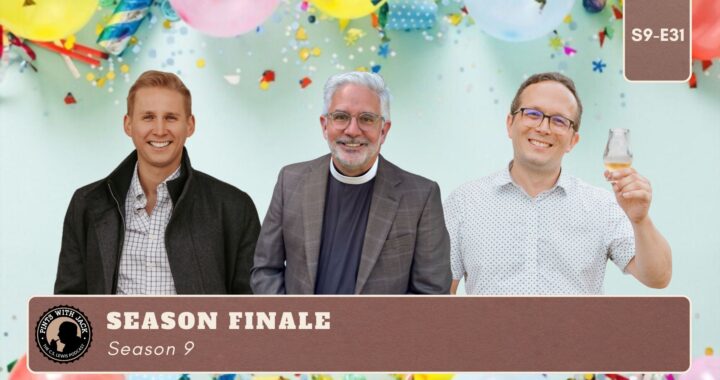
Welcome friends to Pints With Jack! In January we began “The Abolition of Man” and wrapped up Chapter 1 (“Men Without Chests”). This month we start work Chapter 2 (“The Way”).
Quote-of-the-Week
However subjective they may be about some traditional values, Gaius and Titius have shown by the very act of writing The Green Book that there must be some other values about which they are not subjective at all.
C. S. Lewis, The Abolition of Man (The Way)
Chit Chat
Q. This is our first recording of 2026. How was your Christmas and New Year?
- Andrew and his family hosted an annual 12th Night “Secret King/White Camel” gift exchange before the feast of the Epiphany. He’s been editing a series of Lewis essays and just submitted those for editing. And last but not least, on New Year’s Day, Andrew submitted his doctoral thesis for approval!
- David had a stressful beginning of the year, wrapping up a time-sensitive work project while coming down with an illness. On the bright side, as he’s been recovering, he’s had time to catch up on All Creatures Great and Small with his wife.
- Matt’s been preparing for the arrival of his baby, who could be born by the time this episode is released! He’s also been running tests for his new financial AI.
Toast
- Matt opened up a Lagavulin 16.
- Andrew was drinking an Innis & Gunn Scottish Golden Beer.
- David had a Paulaner Hefe-Weizen.
- Today, they toasted Lance Haynie. Cheers!
Discussion
Recap
So we’re about to start discussing Chapter 2 of The Abolition of Man… but before we start, here’s my recap of Lewis’ argument so far…
- In Chapter 1, Lewis introduces us to an English school textbook which he calls “The Green Book”.
- In “The Green Book”, the story of two tourists at a waterfall is recounted, one of whom describes the waterfall as “sublime” and the other who just calls it “pretty”.
- The authors of “The Green Book” say that these remarks merely refer to the subjective feelings of the tourists and say nothing objective about the waterfall itself.
- The philosophy they’re applying is called “Logical Positivism”, the belief that a statement is meaningful only if it can be empirically verified or is true by definition (triangles have three sides). Logical Positivism therefore rejects all metaphysical, theological, and ethical claims, not as “false”, but as cognitively meaningless.
- Needless to say, Lewis criticizes the authors of this book for teaching philosophy when they were meant to be teaching English composition.
- “The Green Book” sets about debunking the sentiments expressed in some poorly-written adverts.
- Jack points out that, were they actually teaching English composition, they would contrast poor writing with good writing!
- The authors of “The Green Book” don’t do this. Instead, all they do is give their pupils the tools to debunk any sentiment, regardless of whether it is expressed in writing which is bad or good.
- The result of this lesson is the cutting out of the pupil’s soul, something which all previous generations have thought to be important.
- Jack points out that, were they actually teaching English composition, they would contrast poor writing with good writing!
- “The Green Book” seems to very much want its readers to be immune from emotional propaganda.
- Jack suggests that one can be protected from the propaganda in one of two ways:
- The first is by having all sentiments excised through teaching found “The Green Book”, transforming readers into “trousered apes” or “urban blockheads”…
- The alternative would be to nurture pupils with well-formed sentiments and emotions.
- Jack suggests that one can be protected from the propaganda in one of two ways:
- Lewis says that “The Green Book” teaches what it does for three reasons:
- Firstly, literary criticism is hard, but debunking emotions is easy!
- Secondly, the authors have misdiagnosed the present educational need, thinking that the chief problem in youth is an excess of emotion – Lewis disagrees.
- Finally, the authors of “The Green Book” may well reject the idea that “certain emotional reactions… could be either congruous or incongruous…[and] that objects did not merely receive, but could merit, our approval or disapproval.”
- Previous generations throughout the world certainly believed this! Jack demonstrates this with many examples (which are expanded upon in the Appendix).
- Lewis describes this doctrine of objective value, not using the western term of “Natural Law”. Instead, he expresses the belief that certain attitudes are really true, and others really false, using the Confucian term, “the Tao”.
- Lewis considers the Latin proverb Dulce et decorum est pro patria mori. In English, this means “It is a sweet and seemly thing to die for one’s country”
- The authors of “The Green Book” would debunk such a sentiment, but would then be faced with the problem of trying to find some other way to inculcate the virtue of bravery in the face of danger and death. Lewis warns that Without the aid of trained emotions the intellect is powerless against the animal organism.
- Jack asks us to consider the human person as being composed of the head (intellect), belly (appetites), and chest (the place of trained sentiments which mediate between the head and belly).
- He claims that the philosophy of “The Green Book” shrinks the chest.
- In his book “C.S. Lewis for Beginners”, Dr. Louis Markos sums up this chapter by saying:
By debunking the objective status of ethics, religion, and aesthetics, educators cause the chest to shrivel. Textbooks like The Green Book not only strip away absolute standards of Goodness, Truth, and Beauty; they ridicule the virtues linked to them. And yet, ironically, as they do so, they loudly complain that young people are apathetic or selfish or immoral.
Dr. Louis Markos, C. S. Lewis for Beginners
Q. I know that was a little long, but I wanted to get the full recap in before moving on to the next chapter. Anything else to add before diving in to the text?
- To give listeners/readers a summarized, TLDR version of the recap:
- The authors of “The Green Book” want to discard any non-imperially provable statements and sentiments.
- The problem begins when they attempt to ground a value they believe in.
- If someone says “there is no absolute truth”, that itself is an absolute statement!
…Atheism turns out to be too simple. If the whole universe has no meaning, we should never have found out that it has no meaning: just as, if there were no light in the universe and therefore no creatures with eyes, we should never know it was dark. Dark would be without meaning.
C. S. Lewis, Mere Christianity
- Even though Gaius and Titius are trying to convince students that things are without meaning, they are counting on their students to accept that their text is meaningful.
01. “Chapter Epigraph”
Q. Before we get into the body of Chapter 2, let’s talk about its epigraph… it’s another one from Confusius: “It is upon the Trunk that a gentleman works.” – Analects of Confucius, 1. 2. What are your thoughts?
- Lewis quotes it at greater length in the Appendix, under the “Law of Special Beneficence”:
It is upon the trunk that a gentleman works. When that is firmly set up, the Way grows. And surely proper behaviour to parents and elder brothers is the trunk of goodness.
C. S. Lewis, The Abolition of Man (Appendix)
- This metaphor either eludes to the trunk of a tree with its branches, or it’s Confucius’ version of “the Chest” of man which we learned about at the end of the last chapter.
- The trunk is the essential “self” of the tree. You could graft on another branch, but it wouldn’t fundamentally change the essence of the original tree.
02. “Destruction of Society”
The practical result of education in the spirit of The Green Book must be the destruction of the society which accepts it. But this is not necessarily a refutation of subjectivism about values as a theory. The true doctrine might be a doctrine which if we accept we die. No one who speaks from within the Tao could reject it on that account; ἐν δὲ φάει καὶ ὄλεσσον. But it has not yet come to that. There are theoretical difficulties in the philosophy of Gaius and Titius.
C. S. Lewis, The Abolition of Man (The Tao)
Q. Jack begins this chapter by saying that the practical result of adopting “The Green Book” is “the destruction of the society which accepts it”… Does he think that therefore means it’s false?
- “The Green Book” is not bad just because it has consequences. The true doctrine might be a doctrine which if we accept we die.
- He says that someone who is within the Tao couldn’t reject “The Green Book” on this basis. This might seem strange, but think about defending a loved one from a deadly attack, or Christian martyrdom…
- What needs to be determined is if the philosophy is coherent. After all, if it’s true, they regardless of the consequences, we should teach it.
Q. Lewis then quotes ἐν δὲ φάει καὶ ὄλεσσον. What does it mean, Matt?
- It’s all Greek to me!
- It’s from Homer’s “Iliad”, said by Ajax to Zeus, a prayer for light, roughly translating to “If we are to die [slain by the Trojans], at least may it be by daylight…” David also found it in the Pulpit Commentary for Job 19:8.
- So, rather than dismiss The Green Book’s philosophy simply because it’ll destroy society, Lewis first wants to test it to see if it’s coherent…
03. “Hypocrisy”
Q. Lewis claims that the authors of the Green Book aren’t subjective about EVERYTHING… What proof does he offer to back up this claim?
- As we said in the opening quotation, however subjective they may be about some traditional values, Gaius and Titius have shown by the very act of writing “The Green Book” that there must be some other values about which they are not subjective at all.
- The proof of this is “The Green Book” itself:
They write in order to produce certain states of mind in the rising generation… because they think them to be the means to some state of society which they regard as desirable… And this end must have real value in their eyes.
C. S. Lewis, The Abolition of Man (The Tao)
Q. Couldn’t Gaius and Titius just say they “agree to disagree”; that they’re pushing their own opinions, but others are free to have different ones?
- The problem is that they’re pushing their opinions on others (namely children) as though there is something to argue about. This isn’t a matter of taste to them, it’s a matter of fact, and they are converting impressionable young minds to their way of thinking.
- It would be like having a different favorite ice cream flavor than your friend, and instead of accepting his differences, you argue with him and tell him he’s wrong for liking strawberry over vanilla.
- Also…you can’t say there are no objective values, then try to push one!
Q. Now, the authors might not describe their goal as “good”, that’s a value after all. They may prefer terms: ‘necessary’ or ‘progressive’ or ‘efficient’. How does Jack say they can be forced past this jargon?
- Ask them to “describe and define” without appealing to emotion. After all, they’ve already taken that off the table!
They could be forced by argument to answer the questions ‘necessary for what?’, ‘progressing towards what?’, ‘effecting what?’; in the last resort they would have to admit that some state of affairs was in their opinion good for its own sake.
C. S. Lewis, The Abolition of Man (The Tao)
- Everything about this is found in “The Screwtape Letters”.
He doesn’t think of doctrines as primarily “true” or “false”, but as “academic” or “practical”, “outworn” or “contemporary”, “conventional” or “ruthless”. Jargon, not argument, is your best ally in keeping him from the Church. Don’t waste time trying to make him think that materialism is true! Make him think it is strong, or stark, or courageous—that it is the philosophy of the future. That’s the sort of thing he cares about.
C. S. Lewis, The Screwtape Letters (Letter #1)
Q. Lewis effectively calls them hypocrites. Why?
- Gaius and Titius are selectively skeptical.
In actual fact Gaius and Titius will be found to hold, with complete uncritical dogmatism, the whole system of values which happened to be in vogue among moderately educated young men of the professional classes during the period between the two wars. Their scepticism about values is on the surface: it is for use on other people’s values: about the values current in their own set they are not nearly sceptical enough. And this phenomenon is very usual. A great many of those who ‘debunk’ traditional or (as they would say) ‘sentimental’ values have in the background values of their own which they believe to be immune from the debunking process. They claim to be cutting away the parasitic growth of emotion, religious sanction, and inherited taboos, in order that ‘real’ or ‘basic’ values may emerge. I will now try to find out what happens if this is seriously attempted.
C. S. Lewis, The Abolition of Man (The Tao)
- They apply skepticism to the values of others, but not when it comes to themselves.
- Additionally, they think they’re cutting off the excesses of western religion and philosophy, but as Lewis shows with the Tao, an underlying sense of right and wrong has existed everywhere since time immemorial.
- Lewis goes into further detail explaining this moral sense in “Mere Christianity”.
My argument against God was that the universe seemed so cruel and unjust. But how had I got this idea of just and unjust? A man does not call a line crooked unless he has some idea of a straight line. What was I comparing this universe with when I called it unjust?
C. S. Lewis, Mere Christianity (Chapter 1)
04. “The New Foundation”
Q. In the last chapter we spoke about Dulce et Decorum Est, the Latin proverb from the Roman poet, Horace, about how it is a sweet and fitting thing to die for one’s country. Lewis is now going to attempt to see what happens when the debunkers, after having discarded all sentiment, attempt to find some other basis for bravery in the face of danger or death… Why do you think he uses this as a test?
- He describes it as the experimentum crucis [crucial experiment] which shows different systems of thought in the clearest light.
- Are you willing to lay down your life for this?
- He also marries Dulce et Decorum Est with the words of Jesus in John 15:13, the Christian version of Horace’s Pagan sentiment:
Greater love has no one than this: to lay down one’s life for one’s friends.
John 15:13
Q. So how might a debunker of traditional morality attempt to justify the value expressed by Horace and Jesus, namely dying for a good cause?
- “The Innovator”, as Lewis calls him, would probably first justify it using a Utilitarian lens, namely that the sacrifice of some would benefit the greater community.
- As in “Out of the Silent Planet”, Lewis translates this into plain terms:
…The death of some men is useful to other men.
C. S. Lewis, Out of the Silent Planet
- …but, doesn’t that just beg the question: on what grounds should these particular men be asked to do this?
- Gaius and Titius can’t appeal to pride, honour, shame, or love… those have already been “debunked”!
To use these would be to return to sentiment and the Innovator’s task is, having cut all that away, to explain to men, in terms of pure reasoning, why they will be well advised to die that others may live. He may say ‘Unless some of us risk death all of us are certain to die’. But that will be true only in a limited number of cases; and even when it is true it provokes the very reasonable counter question ‘Why should I be one of those who take the risk?’
C. S. Lewis, The Abolition of Man (The Tao)
Q. So utilitarianism hasn’t worked. What about reason? Could that be used instead?
- But to what end? You can’t get an “ought” from an “is”. Or, as Jack says:
From propositions about fact alone no practical conclusion can ever be drawn. This will preserve society cannot lead to do this except by the mediation of society ought to be preserved. This will cost you your life cannot lead directly to do not do this: it can lead to it only through a felt desire or an acknowledged duty of self preservation. The Innovator is trying to face.
C. S. Lewis, The Abolition of Man (The Tao)
- The missing piece is this: how do you get from a statement of fact to an “ought” or “should”.
Q. Seeing reason fail to provide an answer, Lewis offers two possible routes forward. What are they?
- The first option is to broaden the meaning of “Reason”.
Extend the word Reason to include what our ancestors called Practical Reason and confess that judgements such as society ought to be preserved (though they can support themselves by no reason of the sort that Gaius and Titius demand) are not mere sentiments but are rationality itself.
C. S. Lewis, The Abolition of Man (The Tao)
- Here’ he’s describing the difference between “Intellectus” and “Ratio”, concepts we’ll dive into further on in the chapter. They’re two faculties of reason. The former is a truth that’s clearly perceived but can’t be worked out through first principles. The later can be worked out through pure reason.
- The trouble is, Gaius and Titius wouldn’t accept this, because this leads us to the Tao, the very thing they’re attempting to replace.
- The only other option is to give up on reason altogether. You can’t use reason to disprove reason!
- Lewis says the Innovator is more likely to do this and look elsewhere, to Instinct. We’ll dive into that next week!
When you argue against Him you are arguing against the very power that makes you able to argue at all: it is like cutting off the branch you are sitting on.
C. S. Lewis, Mere Christianity
Wrap Up
Concluding Thoughts
–
Support Us!
- Subscribe to the audio feed on your preferred podcast platform, such as iTunes, Google Podcasts, Spotify, Audible, and many others…
- Follow us on Instagram, Facebook, YouTube, and Twitter
- See what we have planned for the rest of Season 9
- We would be grateful if new listeners would rate and review us on their preferred podcast platform.
- Finally, if you’d like to support us and get fantastic gifts such as access to our Pints With Jack Slack channel and branded pint glasses, please join us on Patreon for as little as $2 a month.

Love the podcast! I would have a pint with you guys any day. Just a thought to share. I always had a different read of the “pretty vs sublime” waterfall issue. “Sublime” IS an objective quality of something that is beautiful, and to the degree that it produces a “feeling”, it is a numinous feeling with a quality of transcendence in the vein of Rudolph Otto and The Idea of the Holy. “Pretty” is entirely subjective. It is how I feel about that thing that is beautiful. It is a judgement. I don’t think Lewis is saying that both are subjective. I think he’s saying that the correct way to think about the waterfall is that it is sublime. It is not pretty.