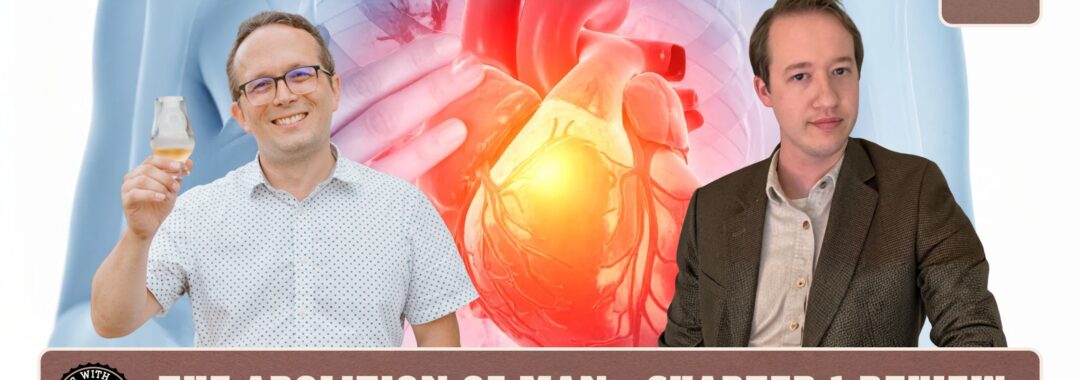
After working through Chapter 1 of The Abolition of Man the past few weeks, Dr. Andrew Snyder joins David to review the chapter as a whole.
Click here to download S9E13: “The Abolition of Man – Chapter 1 Review”
Show Notes
Introduction
This month we’ve completed the reading of Chapter 1 of “The Abolition of Man”. The book is quite dense, so we worked through the chapter over the course of three episodes, but to make sure we don’t get too bogged down in details, today we’re setting aside some time to look at the chapter as a whole with a special guest, Dr. Andrew Snyder.
Quote-of-the-Week
My friend, you would not tell with such high zest
Wilfred Owen, Dulce et Decorum Est
To children ardent for some desperate glory,
The old Lie: Dulce et decorum est
Pro patria mori.
Biography
Dr. Andrew Snyder is a professor with interests in philosophy, theology, and literature. In addition to his university work, he runs “Mythic Mind”, a podcast and YouTube channel which focuses on finding wisdom through stories, with a particular interest in myth, fantasy literature, and the history of ideas.
Chit-Chat
–
Toast
- David drank a Hefeweizen today.
- Dr. Snyder had a mug of coffee.
Discussion
01. “The Making of a Mythic Mind”
Q. To begin with, would you please tell us a little bit more about yourself? I’ve heard you mention bits and pieces of your story retold on Mythic Mind, but would you mind telling our listeners a little bit about your journey and how you came to the Inklings and how you came to start Mythic Mind?
- In college, unsure of what he wanted to do, a business professor steered Dr. Snyder in the direction of philosophy and religion. After eventually obtaining his doctorate in theology, he began taking an interest in fictional literature thanks to online fans, and realized what he needed was “escape, consolation, and recovery”. He tore through “The Lord of the Rings” and “The Silmarillion”, then moved on to Lewis’s “Till We Have Faces”. He’s been a Tolkien/Lewis guy ever since.
02. “Encountering Abolition”
Q. What’s your own history with The Abolition of Man?
- At some point in his sprint through Lewis’s works, he picked up “The Abolition of Man”. As an educator and philosopher, he found that it spoke to him in very profound ways.
- Dr. Snyder has also done two lectures on TAOM, which you can watch below:
03. “The Essential Chest”
Q. What would you say is the core argument to Chapter 1 of “The Abolition of Man”?
- Dr. Snyder argues that the purpose of education is to help us recognize reality. Reality is good, and drawing closer to it makes us more whole. This “drawing closer” to the good and to reality is what we call virtue, which runs in opposition to the modern idea that goodness and reality are subjective to each person.
04. “Is Beauty Really Objective?”
Q. Lewis starts the chapter arguing about what we mean when we call a waterfall “sublime”. While a lot of people might regard morals and objective, I think people generally have a harder time saying that beauty is objective – “Beauty is in the eye of the beholder”, after all. What do you make of that?
- Though we often say that beauty is subjective, we usually don’t live our lives as if that were true. We act as though beauty is a real thing because it is! Beauty is when things are the way they are meant to be, and give life to those who see it.
- The classical understanding of beauty can be found by studying Roman mythology, particularly the muses and the sirens. The muses are the daughters of Zeus who use truth and goodness to inspire artists, writers, and musicians, who in turn create beautiful things that captivate our senses. Meanwhile, the sirens also inspire, but their inspiration is illusory and deceptive. Rather than giving life to its witnesses, they consume it.
Q. The authors of The Green Book would argue that when Lewis calls the waterfall “sublime,” he’s simply talking about his own emotions towards it. Lewis connects this with the broader literary trends of the time, written by contemporaries like I. A. Richards and A. J. Ayer. Could you talk about this background and the philosophy of these authors?
- The philosophy that these authors espoused is called “logical positivism”, which argues that language must be imperically verifiable for it to have any meaning. Calling a waterfall “sublime” when it can’t be objectively proven to them would mean that the other person is just emoting.
- Lewis is trying to snap us out of this spell. Certain things, like the power and grandeur of a waterfall, ought to stir certain feelings in us.
- Another problem with logical positivism is that it so narrows our expression and communication that we can hardly say anything at all, much less anything interesting. It drains the human experience of any real meaning.
05. “Above and Below”
Q. We’ve had some discussion in our episode about what it means to be “above” or “below” the propaganda found in advertising. How do you understand it?
- To be “above” propaganda means that you are attentive to what is good, true, beautiful and real, and are able to recognize manipulation and illusions. On the flip side, being “below” propaganda means that you’ve become numb to what should stir emotion within you. You might not be deceived by propaganda, but it’s only because you aren’t aware enough to perceive it. Someone in this state could see a beautiful painting, and it simply blends into the scenery.
06. “The Tao”
Q. An important concept which is introduced in this chapter is The Tao. What actually is it, and why do you think Lewis uses this term rather than something more familiar like “Natural Law”?
- The Tao is the universal way that people have understood their relation to reality. The reason Lewis uses a more “eastern” phrase is to show that this concept is indeed universal. The term “Natural Law” would have placed it within a Western framework.
Q. Lewis spends some time explaining how one should form themselves in The Tao. Doesn’t that undermine his claim? After all, if The Tao is universal, why does it need to be taught, rather than instinctively recognized?
- Because we are corrupted beings with disordered desires, we need to be formed in what is good for us. Anyone parent who has raised children can understand this! Kids would consistently choose things that are bad for their development, and part of the job of being a parent is steering them towards things that are good for them. Even as adults, we aren’t always act the way we should towards those we love, and have to train ourselves to choose the good of others over ourselves.
- Lewis tackles this question in another way in “Mere Christianity”, through the lens of math.
Other people wrote to me saying, ‘Isn’t what you call the Moral Law just a social convention, something that is put into us by education?’ I think there is a misunderstanding here. The people who ask that question are usually taking it for granted that if we have learned a thing from parents and teachers, then that thing must be merely a human invention. But, of course, that is not so. We all learned the multiplication table at school. A child who grew up alone on a desert island would not know it.
C. S. Lewis, Mere Christianity, Some Objections
07. “The Tripartite Man”
Q. I remember being rather confused when I first read Abolition and Lewis spoke about a person as being tripartite – head, belly, and chest. Given your background in philosophy, could you tell us a bit about the roots of this idea and unpack it for us? I assume it’s all in Plato (what do they teach them in these schools)?
- We do share certain parts of our nature with animals, like hunger, thirst, herd mentality, reproduction, etc. However, many of these instincts conflict with each other. Left to themselves, chaos ensues. What provides unity and direction is the logos, or logic. Because of our reason, we can think beyond “what do I want”, and instead consider “what should I want?” This allows us to say yes to some things, and no to others, depending on circumstances and the time they take place in.
- However, reason alone doesn’t make us virtuous. We can know the right path and have the ability to follow it, and choose not to. That’s why in Aristotle’s “Nicomachean Ethics”, he says that rather than just learning about ethics, we need to practice being ethical.
The virtues on the other hand we acquire by first having actually practised them, just as we do the arts. We learn an art or craft by doing the things that we shall have to do when we have learnt it: for instance, men become builders by building houses, harpers by playing on the harp. Similarly we become just by doing just acts, temperate by doing temperate acts, brave by doing brave acts.
Aristotle, The Nicomachean Ethics II
Q. Why doesn’t Lewis stop at the head and the belly? Why does he include the chest? Couldn’t we govern our impulses by reason alone?
- Humans are not animals (appetite), nor are we angels/spirits (reason). We are body-soul composites, which means we have a physical experience. This means that to be fully formed, we have to act.
- Dr. Snyder related having a formed chest to Aristotle’s “golden me”, which is knowing the best course of action and acting prudently.
- Reason alone doesn’t save you from immorality. After all, angels are pure reason, and a third of them became demons!
08. “Cassandra or Jonah?”
Q. One of these Biblical prophets was listened to, while the other was not. Likewise, do you think Lewis’ warnings in this chapter have been heeded at all?
- Lewis tends to be a good prophet in his time for how society was tracking, and the consequences that were to come. On a broad scale, he’s been ignored by the culture. But in certain contexts and communities – such as the classical homeschool movement – the idea’s still there.
Q. Lewis criticizes others for writing a philosophical work under the guise of an English textbook. But isn’t he guilty of the same thing (ie: “sneaking past watchful dragons”)?
- Lewis gets a pass here for two reasons. First, his philosophy is actually good. Second, he’s usually pretty honest and transparent about what he’s trying to accomplish. For example, at the end of “Out of the Silent Planet”, he ends the book by explicitly warning that unless someone does something, people like Weston will continue to rise up.
09. “Sweet and Fitting”
Q. Lewis ends the chapter by considering the poet Horace’s phrase “Dulce et decorum est pro patria mori”. How does this present a problem for the authors of The Green Book?
- Certain actions merit certain affections from us. This isn’t a problem for Lewis, but it is for the authors of The Green Book, because while they might agree with the sentiment, they can’t justify it. Their philosophy doesn’t allow them to appeal to virtue. They would have to appeal to a Nietzschean appeal to power, imposing their personal feelings and will onto others. And now, we’re back to propaganda. Ultimately, you saw off the branch on which you’re sitting.
- There was once a debate at Oxford over whether or not they would go to war against Germany. The resolution was “no”. Yet, when World War II happened, there was massive enlistment. Rationally, self-preservation seems to be the highest good. But there is something higher than your own will to survive.
- Lewis gives another example of this in “Mere Christianity”, of deciding whether or not to save a drowning person:
Supposing you hear a cry for help from a man in danger. You will probably feel two desires—one a desire to give help (due to your herd instinct), the other a desire to keep out of danger (due to the instinct for self preservation). But you will find inside you, in addition to these two impulses, a third thing which tells you that you ought to follow the impulse to help, and suppress the impulse to run away. Now this thing that judges between two instincts, that decides which should be encouraged, cannot itself be either of them. You might as well say that the sheet of music which tells you, at a given moment, to play one note on the piano and not another, is itself one of the notes on the keyboard. The Moral Law tells us the tune we have to play: our instincts are merely the keys.
C. S. Lewis, Mere Christianity, Some Objections
10. “The Practical Application”
Q. What do you think are the practical applications of this chapter, particularly regarding education?
- The appropriate response is to reclaim control of education. This starts with yourself, first and foremost. Are you loving the good? Do you have the right affections for things? Are you practicing what you’ve learned? Or, are you just going along to get along?
- When it comes to others, we need to revamp classical Christian education. There needs to be a mindset shift, recognizing that education is not just about knowing things, but becoming good people. Without habitual virtue, we end up with the modern-day education system, which produces people who often choose wrong because of the seeds that were sown throughout their schooling.
Education without values, as useful as it is, seems rather to make man a more clever devil.
C. S. Lewis
- David explained how through Lewis’s stories, he showed his son Alexander how it was good to help his siblings.
Wrap Up
Concluding Thoughts
- “The Abolition of Man” is a very relevant text for understanding the times we’re living in, and it’s a good reminder of the classical world we’ve left behind in favor of modern propaganda.
More Information
- Follow Dr. Snyder on X.
- Listen to the Mythic Mind Podcast, where Dr. Snyder goes over philosophical topics within fictional worlds.
Support Us!
- Subscribe to the audio feed on your preferred podcast platform, such as iTunes, Google Podcasts, Spotify, Audible, and many others…
- Follow us on Instagram, Facebook, YouTube, and Twitter
- See what we have planned for the rest of Season 9
- We would be grateful if new listeners would rate and review us on their preferred podcast platform.
- Finally, if you’d like to support us and get fantastic gifts such as access to our Pints With Jack Slack channel and branded pint glasses, please join us on Patreon for as little as $2 a month.

For lovers of Perelandra you might be interested in watching this contemporary dance feature that tells the story of Perelandra from an indigenous, de-colonial lens: https://www.youtube.com/watch?v=vgzQOEJrfl8. Would be interested in what your take on it might be.
Thanks, I’ll take a look