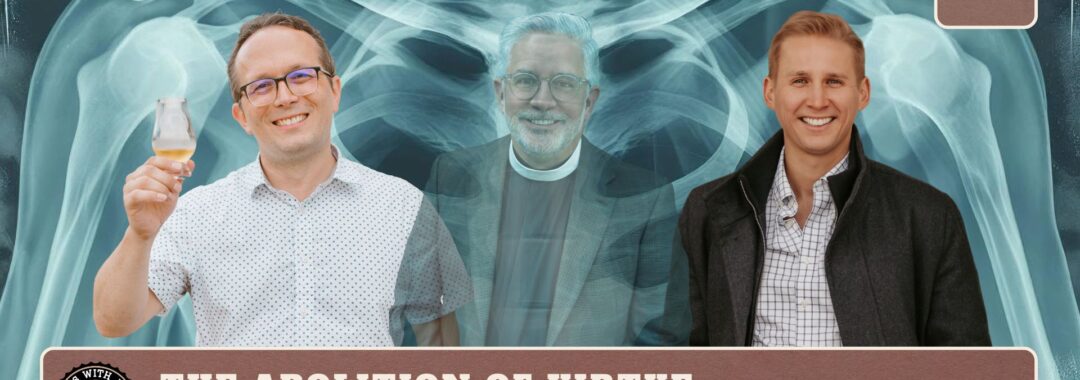
Andrew disappears after a couple of minutes, leaving David and Matt to wrap up the final part of Chapter 1…
Click here to download audio for S9E10: “The Abolition of Virtue”
Show Notes
Introduction
Quote-of-the-Week
The head rules the belly through the chest—the seat, as Alanus tells us, of Magnanimity, of emotions organized by trained habit into stable sentiments. The Chest — Magnanimity — Sentiment — these are the indispensable liaison officers between cerebral man and visceral man.
C. S. Lewis, The Abolition of Man (Chapter 1)
Chit Chat
- David recently pre-recorded an interview with Dr. Paul Fiddes on the subject of Charles Williams, which will be released towards the end of the season.
- Matt and his wife went to see the Radio City Rockettes in concert, and was surprised at how it has remained true to the Christian parts of the original performance, even after all these years.
Toast
- Andrew had a mug of coffee.
- David’s slumming it with some Taifu tea (his next Yorkshire Gold shipment is on its way).
- Matt was drinking a cup of Yerba Mate tea.
- Today, we toasted patron Lucy Dearden Jones…cheers!
Discussion
Recap
Before we dig into the final section of Chapter 1, a little recap of what we’ve read so far…
- When we began Chapter 1 of “The Abolition of Man”, Lewis introduced us to an English school textbook which he dubbed “The Green Book” written by “Gaius” and “Titius”.
- The book began by recounting the story of two tourists at a waterfall, one who described it as “sublime” and the other who called it “pretty”.
- Gaius and Titius said that these remarks only refer to the subjective feelings of the tourists, not anything objective about the waterfall.
- Lewis said that, in the place of English composition, the pupils were being subtly taught a philosophy that… “all sentences containing… [an assertion] of value are statements about the emotional state of the speaker… [and that] all such statements are unimportant.”
- The book began by recounting the story of two tourists at a waterfall, one who described it as “sublime” and the other who called it “pretty”.
- In the section we looked at last week, Lewis pointed out that Gaius and Titius (as well as the author of another book whom he called “Orbillius”), if they really wanted to teach English composition, they should place bad writing alongside good writing.
- What they do instead is simply share poorly-written adverts and debunk the emotions expressed in them. However, the same debunking strategy can equally be applied to well-written literature which explores the same emotion.
- In teaching a pupil to read cynically and overly-literally, authors like Gaius, Titius, and Orbillius “while teaching…nothing about letters, have cut out of his soul, long before he is old enough to choose, the possibility of having certain experiences which thinkers of more authority than they have held to be generous, fruitful, and humane…”
- Lewis points out that two kinds of people are inoculated against writing which manipulates emotions:
- The first kind of person is someone with well-formed sentiments and well-formed emotions.
- The second kind of person who remains untouched by such propaganda is the trousered ape or urban blockhead who has had these emotions cut out. This is the result of works like “The Green Book”…
- Lewis ended the section last week by suggesting three possible reasons why these authors have written books of this nature:
- Firstly, literary criticism is hard, but anyone can engage in debunking emotions…
- Secondly, they have possibly misdiagnosed the present educational need, thinking that the chief problem of youth is an excess of emotion…
- …and thirdly another reason, which we’ll explore in today’s episode!
01. “Modern Educational Assumptions”
Q. Lewis describes what comes next as a digression, but I’m not really sure why, since I think it’s at the heart of his argument. What does Lewis say is unique about some modern educators?
- They disagree with pretty much everyone who came before them!
- This is a common characteristic of modernists. They disregard all the great thinkers of history, and think that they are the enlightened ones, while other forms of thinking were from a primitive era.
- A more charitable read of it could be that these educators have never read the old works, and as such, don’t understand classical ways of thinking.
- Previously, people thought the universe to be such that certain emotional reactions on our part could be either congruous or incongruous to it—believed, in fact, that objects did not merely receive, but could merit, our approval or disapproval, our reverence, or our contempt, based on objective principles.
- For a more in-depth analysis on how modernists think and how we got here as a society, Matt recommends Carl Trueman’s book “Strange New World”.
Q. How does this apply to their opening example of the waterfall?
- Coleridge and the tourists all believed that certain responses to nature could be more ordinate/appropriate/objective than others.
- Someone who described that the waterfall was sublime was actually claiming that the scene merited that response, not because of his subjective emotions, but because it was objectively worthy of that description.
- If “This is pretty” only described the person’s feelings about the waterfall, it would be absurd to disagree, equivalent to someone saying “I feel sick” and another person disagreeing, saying “No, I feel quite well”!
On this view, the world of facts, without one trace of value, and the world of feelings without one trace of truth or falsehood, justice or injustice, confront one another, and no rapprochement is possible.
C. S. Lewis, The Abolition of Man (Men Without Chests)
02. “The Aeolian Lyre”
Jack then takes a tour of thought throughout the world across the ages, showing that people have recognized that some responses are more appropriate than others…
Q. He begins with referencing Percy Shelley who compared human sensibility (our emotional response) to an Aeolian lyre. First of all, what’s an Aeolian lyre and how does it compare to human sensibilities?
- The Aeolian Lyre is named after Aeolus, the ancient Greek god of the wind, it’s a wooden box instrument with strings stretched lengthwise across two bridges. It’s often placed in a slightly opened window where the wind can blow across the strings to produce harmonic sounds.
- Like the lyre that responds to external stimuli, we respond to the world around us, and the way we are “made” (environment, upbringing, etc) determines our natural responses. But, unlike the instrument, Shelley says that humans can adjust internally how they respond to things. Basically, we can tune ourselves to make sure that we respond appropriately, rather than having our response predetermined.
03. “A Tour Through The Ages”
Q. Who/what else does he reference in his tour through the ages?
- A bunch! Here’s a list:
- Thomas Traherne, a 17th Century Anglican clerk who said “Can you be righteous unless you be just in rendering to things their due esteem? All things were made to be yours and you were made to prize them according to their value.”
- St. Augustine of Hippo, who defines virtue as ordo amoris (order of love), or the ordinate condition of the affections in which every object is accorded that kind and degree of love which is appropriate to it.
- Aristotle who says that “the aim of education is to make the pupil like and dislike what he ought”. He says that if he’s been trained in ordinate affections he’ll easily find the first principles in Ethics.
- Plato (“Who died and left Aristotle in charge of ethics?”)
- Hinduism (a little outside our wheelhouse)
- The Jewish Law (the Torah)
- The Chinese Tao: “It is the reality beyond all predicates, the abyss that was before the Creator Himself. It is Nature, it is the Way, the Road… It is also the Way which every man should tread in imitation of that cosmic and supercosmic progression, conforming all activities to that great exemplar.“
- They compared it to the order of love prior to and then within marriage.
“You saw yesterday, Daughter, how little progress I have made. I began to philosophise too late. You are younger and can go further.”
– Till We Have Faces (Part I, Chapter 8)
04. “The Tao”
Q. Moving forward, Lewis says he’s going to describe all of these ideas, for the sake of brevity as “the Tao”. Why do you think he settles on that shorthand?
- It’s not Christian, or even western. It is common to all humanity.
Q. What does he say is the idea that’s at the heart of the Tao?
- The Doctrine of Objective Value
It is the doctrine of objective value, the belief that certain attitudes are really true, and others really false, to the kind of thing the universe is and the kind of things we are.
C. S. Lewis, The Abolition of Man (Men Without Chests)
- It recognizes that objects demand certain responses from us. Lewis gives the example of this, funnily enough, coming from one of the most prominent children’s authors:
I myself do not enjoy the society of small children: because I speak from within the Tao I recognize this as a defect in myself—just as a man may have to recognize that he is tone deaf or colour blind. And because our approvals and disapprovals are thus recognitions of objective value or responses to an objective order, therefore emotional states can be in harmony with reason (when we feel liking for what ought to be approved) or out of harmony with reason (when we perceive that liking is due but cannot feel it). No emotion is, in itself, a judgement: in that sense all emotions and sentiments are alogical. But they can be reasonable or unreasonable as they conform to Reason or fail to conform. The heart never takes the place of the head: but it can, and should, obey it.
C. S. Lewis, The Abolition of Man (Men Without Chests)
- These defects in yourself can be remedied with exposure and practice. Continuing with the example of children, a person who had little exposure to kids when they were younger can learn to interact with them through babysitting the children of others, for instance.
05. “The Tao vs The Green Book”
Q. In what way is the Green Book in opposition to the Tao?
- It doesn’t think that sentiment can be reasonable or unreasonable!
- To be reasonable or unreasonable is to say how it relates to something else, namely reality (just as to say that a shoe fits is to speak not only of shoes but of feet), but they don’t think that can be done since they claim that any sentence which contains a predicate or assertion of value only, in fact, emotion and therefore is not related to reason.
- It’s interesting how the pendulum has swung. Back in Lewis’s day, philosophers were attempting to remove sentimental statements to alter reality, and today, people are being guided by their emotions, and believe that they are themselves reality!
06. “Dulce et decorum est pro patria mori”
Q. Jack offers a concrete example to examine based on the Latin phrase “Dulce et decorum est pro patria mori”. What does this mean and how does it connect to what he’s been saying?
- It means “It is a sweet and seemly thing to die for one’s country”.
- Lewis paints a picture of a Roman father saying this to his son:
He was communicating to the son an emotion which he himself shared and which he believed to be in accord with the value which his judgement discerned in noble death.
C. S. Lewis, The Abolition of Man (Men Without Chests)
Q. How would Gaius and Titius debunk this Roman notion?
- They would say that death is not edible, and therefore can’t be “sweet”, not even by analogy. “Seemly” only refers to how people still alive will regard someone who died in this way (and they’d cynically point out that they would think about this rarely).
- As with everything else they say, it’s an overly simplistic reading. When you read the implications of the logical positivist worldview, it feels very shallow.
Q. Gaius and Titus now have a dilemma, either they must debunk this notion, or find some other way of justifying this sentiment simply because it is useful to others. Lewis talks about some consequences of attempting the latter – what are they?
- Education transforms from initiation to conditioning and propaganda. Rather than passing on true knowledge, it’s about controlling the thinking of others, and inculcating their minds with false beliefs.
It’s the difference between older birds teaching younger birds to fly and poultry-keepers dealing with them – manipulating them for purposes of which the young birds know nothing.
C. S. Lewis, The Abolition of Man (Men Without Chests)
- Of course, since Gaius and Titius hate propaganda (although their philosophy gives no ground for condemning it), Lewis suggests that they are probably better men than their espoused principles, and thinks that they could vaguely justify it on some other grounds.
They probably have some vague notion (I will examine it in my next lecture) that valour and good faith and justice could be sufficiently commended to the pupil on what they would call ‘rational’ or ‘biological’ or ‘modern’ grounds, if it should ever become necessary. In the meantime, they leave the matter alone and get on with the business of debunking.
C. S. Lewis, The Abolition of Man (Men Without Chests)
07. “Virtue without objectivity”
Q. But assuming that virtues could be justified somehow without appealing to objective value. What’s the problem?
- That doesn’t make a man virtuous! If there’s nothing to base your morality on, how will society be considered “moral”?
- S5E45 – Apologetics Month: “The Moral Argument” – After Hours with Trent Horn
…no justification of virtue will enable a man to be virtuous. Without the aid of trained emotions the intellect is powerless against the animal organism.
C. S. Lewis, The Abolition of Man (Men Without Chests)
- Lewis says he’d prefer to live in a world with men who have trained emotions.
I had sooner play cards against a man who was quite sceptical about ethics, but bred to believe that ‘a gentleman does not cheat’, than against an irreproachable moral philosopher who had been brought up among sharpers.
C. S. Lewis, The Abolition of Man (Men Without Chests)
- People connect with and act on deep sentiment more than something they only intellectually believe. This is especially true in dangerous situations.
In battle it is not syllogisms that will keep the reluctant nerves and muscles to their post in the third hour of the bombardment. The crudest sentimentalism (such as Gaius and Titius would wince at) about a flag or a country or a regiment will be of more use.
C. S. Lewis, The Abolition of Man (Men Without Chests)
08. “It’s all in Plato”
Q. Obviously, it’s all in Plato, but what does Plato say?
- Plato said:
As the king governs by his executive, so Reason in man must rule the mere appetites by means of the ‘spirited element’. The head rules the belly through the chest.
- The chest is the seat of magnanimity, of emotions organized by trained habit into stable sentiments. It is the liaison between “cerebral man [head] and visceral man [belly]”.
Q. Why does Lewis say that it’s our chest that makes us human?
- He says that “by this middle element that man is man: for by his intellect he is mere spirit and by his appetite mere animal.” In other words, we would be either angels, or beasts, and we are neither; we’re a hybrid. This is the tripartite view of man.
Q. However, what’s the effect of the Green Book on this?
- It will produce Men without Chests. a person who operates based on a materialist, Machiavellian philosophy.
- Lewis pokes fun at Gaius and Titius for calling themselves “intellectuals”. Their heads seem big only because their chests are so small!
It is not excess of thought but defect of fertile and generous emotion that marks them out. Their heads are no bigger than the ordinary: it is the atrophy of the chest beneath that makes them seem so.
C. S. Lewis, The Abolition of Man (Men Without Chests)
- It removes the very thing we’re wanting.
And all the time—such is the tragi-comedy of our situation—we continue to clamour for those very qualities we are rendering impossible. You can hardly open a periodical without coming across the statement that what our civilization needs is more ‘drive’, or dynamism, or self-sacrifice, or ‘creativity’. In a sort of ghastly simplicity we remove the organ and demand the function. We make men without chests and expect of them virtue and enterprise. We laugh at honour and are shocked to find traitors in our midst. We castrate and bid the geldings be fruitful.
C. S. Lewis, The Abolition of Man (Men Without Chests)
Wrap Up
Concluding Thoughts
–
Support Us!
- Subscribe to the audio feed on your preferred podcast platform, such as iTunes, Google Podcasts, Spotify, Audible, and many others…
- Follow us on Instagram, Facebook, YouTube, and Twitter
- See what we have planned for the rest of Season 9
- We would be grateful if new listeners would rate and review us on their preferred podcast platform.
- Finally, if you’d like to support us and get fantastic gifts such as access to our Pints With Jack Slack channel and branded pint glasses, please join us on Patreon for as little as $2 a month.