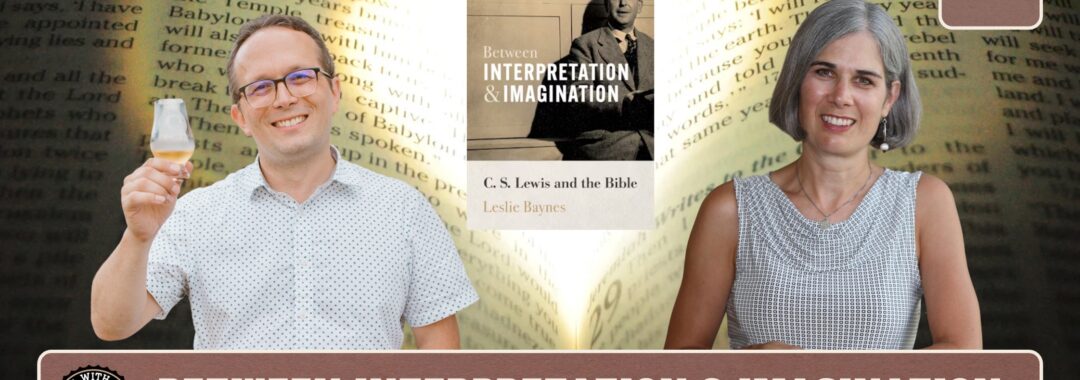
Biblical scholar Dr. Leslie Baynes joins David to discuss her new book “Between Interpretation and Imagination”, a deep dive into Lewis’ perspective on Sacred Scripture.
Click here to download audio for S9E6: “Between Interpretation and Imagination”, After Hours with Leslie Baynes
Show Notes
Quote-of-the-Week
[Lewis] loved a healthy intellectual brawl, and I would have liked to see how he might respond to this book…. it is great fun to watch Lewis tilt at scholarly windmills [attack imaginary scholarly enemies] in his nonfiction, because there is almost always something to learn from him, and occasionally he scores a hit. Win or lose, it is a fight worth watching.
Leslie Baynes, Between Interpretation & Imagination
Introduction
C. S. Lewis’ approach to Scripture can sometimes be surprising. For example, when David read “Mere Christianity”, he realized that there was only one direct scriptural reference in the entire book. It was in a footnote early on, simply relating the origin of the name “Christian”. More importantly, he’s seen members of online groups scandalized upon discovering his views on inerrancy don’t quite match their own.
We haven’t delved too much into the subject of Lewis and Scripture in the past, except for Andrew’s interview with Dr. Michael Christensen where they spoke about his own book, “C.S. Lewis on Scripture“ and discussed the unpublished chapter on Scripture from “Letters To Malcolm”. So, today we’re going to further explore this area in “Between Interpretation & Imagination: C. S. Lewis and the Bible”, recently released by Dr. Leslie Baynes.
Biography
Dr. Baynes is associate professor of New Testament and Second Temple Judaism at Missouri State University in Springfield, Missouri. She has served as scholar-in-residence at the Kilns (Lewis’s home outside Oxford), as an Inklings Project Fellow, and as a translator for the New American Bible Revised Edition.
Chit Chat
- Dr. Baynes was at the Oregon C. S. Lewis conference at George Fox University last year, the same time that David and Andrew went. As an academic, she’s attended hundreds of conferences, but this was her first Lewis conference.
Toast
- David was drinking an Angry Orchard Cider.
- Dr. Baynes had an Irish coffee, with her husband’s homemade Irish Bailey Cream.
Discussion
01. “Any illustrators in the family?”
Q. Since, in preparing for this interview I’ve referred to you as “Pauline Baynes” about a million or so times, can we just clear that up? Are you any relation to the illustrator of “The Chronicles of Narnia”?
- Sadly, no. Baynes is her married name, though her husband does have Scottish roots.
02. “Journey with Jack”
Q. Before we turn to your book, would you mind telling us about your journey with C. S. Lewis and explain how you came to write a book on his approach to scripture?
- Dr. Baynes began reading the Chronicles when she was in grade school. After devouring Lewis’ fantasy series, she bought whatever she could find, including “Mere Christianity”, “The Screwtape Letters”, “The Great Divorce”, “Surprised by Joy”, “Till We Have Faces”, and a few more. She read all of these before going to college.
- When she was at college majoring in English, Dr. Baynes met her great life mentor, Fr. James Heft, her own (religious) Professor Kirkpatrick. He taught a course on Lewis in Dr. Baynes’ final semester, but she couldn’t fit it in her schedule if she were to graduate. It was heartbreaking!
- Time went by, and Dr. Baynes achieved a Master’s in theological studies. and a PhD in Christianity and Judaism in Antiquity. She began teaching at MSU. One day, her department head knocks at the door and asked her an interesting question: If you could teach anything you wanted, what would it be? Without much hesitation, she replied, C. S. Lewis, who she began educating students about in 2007.
- One of her honors students wanted to host “an evening with C. S. Lewis” and invited Dr. Baynes to speak on Lewis and the Bible. She decided to discuss his “liar, lunatic, or Lord” argument, and how he defended it from Scripture. However, she disagreed with some of Lewis’ use of Scripture there, and a woman in the crowd got upset with her, thinking she didn’t like the author. Dr. Baynes decided to write a more scholarly version of the paper to the organizations she aligned with. This caused wide intrigue and more controversy. She turned it into a formal paper for publication, and eventually decided to write a book on the matter.
03. “Disagreeing with Lewis”
- There are many people out there who seem to believe that Lewis can do no wrong. No human is perfect, even our favorite authors. Healthy criticism was a huge characteristic of the Inklings, after all, and Lewis certainly seemed to enjoy critiquing others, from his fellow academics to even the children who sent in their own drafts of stories!
04. “Ad Fontes!”
Q. What did your research for this book look like?
- To begin, she went back through nearly all of Lewis’ works, especially diving into secondary literature.
- During her sabbatical, she traveled to Oxford, and temporarily became the scholar in residence at the Kilns, where she was able to reference Lewis’ libraries. Dr. Baynes also made multiple trips to the Mariam E. Wade Center (heaven on earth) to research Jack’s annotated works that referenced scripture.
05. “Part 1 – Jack’s Life with Scripture”
Q. Your book is divided into three sections, with the first part being a brief biography of Lewis’ interaction with scripture. How do you trace it and what are some of the highlights which you think are particularly important?
- Lewis was born into a family that attended the Church of Ireland, but he lost his faith while attending boarding school. However, both as a Christian and as an atheist, Lewis had a great grasp of the Bible, as is made apparent by his quoting really obscure passages, such as 2 Kings 5:18, that he must “bow myself in the house of Rimmon.”
- In a lecture he gave in 1950 on the literary impact of the Authorized Version (which is the King James Version), he said that for centuries, everyone knew the Holy Bible, and used it in one of two ways: reverently or facetiously. And, from what we can see from his letters, Jack was absolutely in Camp Facetious! Whenever he quoted Scripture, it was to make a satirical point. When he became a theist, he started reading the Bible “seriously,” and he tells his friend Arthur Greeves that he read the Gospel of John in Greek.
- It’s really important to note that he was excellent with Classical Greek, thanks to his knowledge of the classics, and the standards of Oxford. And while anyone can be a great Christian (and a great saint!) with no Greek at all, if you’re to interpret and understand Scripture on an advanced level, you must read Greek. So, Lewis reads John in Greek and says to his friend Greeves, “After that most other things are a come down; and adds “not that I liked that in all respects either.”
- We see that when Lewis recovers his faith and starts reading the Bible reverently, the Gospel of John is there from the beginning. Dr. Baynes argues that this Gospel becomes a lens through which Lewis encounters Scripture and Jesus.
06. “James Moffat”
Q. Where does Lewis go from there, through the rest of his career? You cite James Moffatt’s book The Theology of the Gospels and two of Charles Gore’s works: Jesus of Nazareth and Lux Mundi. Would you mind introducing the authors and these key works?
- As Jack is coming to faith, he also reads secondary literature about Scripture. The three Dr. Baynes emphasizes most are James Moffatt, Charles Gore, and Sr. Penelope Lawson. We’ll be having an episode dedicated to the Sister next season!
- James Moffatt was a Scottish biblical scholar, pastor, and author. His best-known works were his Bible translations, which Lewis read, used, and recommended to others throughout his lifetime. Lewis read “The Theology of the Gospels” around 1930-31, right on the cusp of his conversion. Moffatt argued that all four gospels “give us one theology” a line Lewis underlined in his personal copy, and something Dr. Baynes believes he held to for the rest of his life. But to biblical scholars, this view harmonizes the gospels too much, taking away from the differences between each of the four books written by different authors. For example, many believe that Mark was the earliest gospel, and the others partially used it for inspiration, or made edits to the copy. Early Church authorities like Sts. John Chrysostom, Origen and Jerome recognized this, taking note of the differences, contradictions, and errors in the gospels.
07. “Patristic Textual Criticism”
–
08. “Charles Gore”
- Charles Gore was a huge figure in the Anglican Church, earning his notoriety from publishing his edited volume “Lux Mundi” in 1889. His most famous contribution was the chapter “The Holy Spirit and Inspiration,” which provoked controversy for many reasons. Gore wanted to engage the biblical scholarship that was coming out of Germany that scandalized some people. However, he thought that some books of the Bible – like Jonah and Job – were fiction, and he thought that Jesus could be wrong! But by the time Lewis wrote, Gore had been bishop of Oxford and was thought to be a very principled, staunch conservative church figure. Lewis read many of Gore’s works including “Lux Mundi” and “Jesus of Nazareth”, and followed Gore exactly on many things, including the ideas that the Bible was not inerrant; that it was Jesus, not the Bible, who is the true word of God; in considering books like Jonah and Job fiction, and that Jesus could be wrong (based on the idea of Kenosis, Lewis believed that error could reside in Christ’s human nature). Gore was a big figure at a very impressionable time for Lewis.
09. “Sister Penelope”
- When Lewis was writing “The Problem of Pain” in 1939, Lewis received a fan letter from Sr. Penelope. She had loved reading “Out of the Silent Planet”, and must have also included a copy of one of her own published books “God Persists”, because Lewis talks about it in detail in his response to her, saying he got more out of it than a slew of Gifford lectures, which were premiere talks to attend! Lewis would go on to consult Sr. Penelope over and over again because she was fluent in multiple languages, including Hebrew, which he could not read himself. Unfortunately, not much is known about this nun: most of the information we’ve read is from the book “No Ordinary People”.
10. “Part 2: Case Studies & Controversies”
Lewis always tried to stay away from interdenominational issues, but he didn’t stay away from every controversy. The second section of your book examines some of the issues and controversies into which he injected himself. Honestly we could talk for hours about each of the areas you examine, but because of time-constraints I just want to set the scene and then focus on a couple of them…
Q. Broadly speaking, what were the kind of issues with which Lewis engaged?
- Because he tried to dodge controversy, most of what we know about his own specific beliefs come from letters he sent in response to people asking him questions.
11. “Inspiration & Inerrancy”
- There are a few less-prominent places that he chose to take on issues of scriptural inherency and inspiration, most notably in his little book “Reflections on the Psalms”. He has a lovely chapter there devoted to his views on Scripture that Dr. Baynes believes is the best thing he ever wrote. He first clarifies that though he believes the pages are the oracles of God, he isn’t a fundamentalist, which he defines as someone who takes everything in the Bible as being both historically and scientifically correct. He finds the Bible confusing and difficult, and can’t be completely comfortable with it, including Paul, whom he struggles to understand, and even Jesus, calling him the most elusive of teachers.
- But Lewis, always wanting to look for grace in things, says that God makes the Bible unclear on purpose—so that readers won’t rely solely on it, but instead conform themselves to the image of God revealed in the person of Christ. For Lewis, the goal of all creation is what we term “theosis”, meaning to be conformed into the image of God, human or otherwise. And if the Bible has things in it like Psalm 137:9, the infamous verse about blessed are those who crack the heads of Babylonian babies against walls, he has no problem calling it wicked and even devilish.
12. “Fern-seed and Elephants”
Q. I’d like to address the elephant (or rather, the Fern-seed and Elephants) in the room! In the early reviews of your book, when criticisms are offered by the reviewer, even when it’s coupled with praise, this is the section with which they take issue. Would you like to address any of those concerns here?
- “Fern Seed and Elephants” is certainly more colorful, but she prefers it because the original 1967 title “Modern Theology and Biblical Criticism” was less clear. Since this book is so new, there are few reviews, and none of them yet are from biblical scholars. The early reviewers have not been open to basic biblical scholarship, and seem critical of it. Dr. Baynes believes they could be missing out on quite a lot.
- An equally serious common denominator among early critics is that they don’t seem to think that Lewis could be wrong! One said that “Lewis read everything and remembered all he wrote,” so he DID “understand the fullness” of the biblical scholars he argued against, which is silly. According to Dr. Baynes, they are picking on fern seeds and missing the elephant in Lewis’ room. Repeatedly, she shows that Lewis has misread his interlocutors in the essay.
- For example, Lewis’ essay MTBC begins with a critique of a paragraph in the biblical commentary of Charles Gore. This paragraph appears in the chapter on the Gospel of John. The chapter was written by the scholar Walter Lock, and Lewis picks on this paragraph in “Miracles” also, written nearly a decade prior. Lewis reads Lock as saying that the gospels are a “spiritual romance” or allegory by genre, and therefore could not contain historical truth. But if he’d read more carefully, Lewis would have seen that Lock said exactly the opposite. Lock writes, “If this were so” that is, IF John were this romance or allegory, it would be useless look for chronology or identify allusions in the gospel. Lock says John is not an allegory, but a history! So Lewis berates Lock for saying something he argued against.
- Dr. Baynes later mailed me to say that she misspoke when she said that biblical scholar T. Francis Glasson addressed John as allegory.
13. “Higher Criticism”
Q. In Lewis’ essay he pushes back quite a bit against “Higher Criticism”. What is Higher Criticism and where do you think Lewis falls short?
- When the term was first invented, Higher Criticism referred to what you began after completing “Lower Criticism”. Lower Criticism is textual, which studies the similarities and differences of manuscripts, with the end goal of ending with a more reliable document. With this in mind, we can understand Higher Criticism as what happens after we have this reliable document. The problem is that it has so many different meanings!
- There is also Source Criticism, which, as you may have guessed, is understanding the sources used by the authors of the text(s). We talked about this earlier with Mark being the source for the other gospel texts.
14. “The Trilemma”
Q. You spend a good number of pages looking at Lewis’ trilemma and with something of a critical eye. What is the issue?
- The main issue is that Lewis reads fourth century definitions of the terms God, Son of God, and pre-existent back into first century documents. In “Studies in Words”, Lewis says you must read words in old books to understand what they meant when written, but he completely ignores his own advice here when talking about the writing of the Old Testament and the Christological counsels of the 4th century. He talks about “monotheistic Jews” who would never call a human being God or son of God, but in fact, these Jews do that for centuries. This is the first problem. The second is that, occasionally when Lewis claims that Jesus says something, he doesn’t quote Scripture but instead a mishmash of things that he reads into the text.
- For example, Lewis writes, “Jesus says again: ‘I am the begotten of the one God; before Abraham was, I am.” While the second part is real Scripture from John 18:58, the first part of it is completely made up, and is in fact found nowhere in the New Testament.
- Another example is when Lewis claimed that Jesus said “I am the Anointed, the Son of the uncreated God, and you shall see me at the end of all history as the judge of the universe.” Though this is a perfect statement of Christian theology fleshed out by Church fathers and in later counsels, Jesus never said it. When you argue that Jesus is a liar, a lunatic, or the Lord, and you base it on what Jesus said, you better make sure that Jesus actually said it!
15. “Part 3: Past Watchful Dragons”
The final section of your book is devoted to Lewis’ subtle uses of scripture in The Chronicles of Narnia, the part of your book which receives most unadulterated praise.
16. “Goal and Motivation”
Q. What was your aim in writing this final section?
- She didn’t plan to initially because it would make the book much longer, but she had several people asking for her to. Reading the Chronicles through the lens of these questions was very revealing.
17. “His other fiction?
Q. Was there a particular reason you focussed on Narnia, rather including his other fiction?
- The book just flowed better this way. Other books are interspersed throughout the book, including “Perelandra”.
18. “The Horse and His Boy”
Q. Could you please give us an example of the sorts of things you explore, using my favorite Chronicle, “The Horse and His Boy”?
- Near the beginning of the book, Bree tells Shasta to steal saddlebags with money in them. Though he’s had a rough upbringing, Shasta doesn’t think this is a good idea, yet Bree calls it “booty” and “spoil”. This reminds us of the parable of the unjust steward in Luke 16.
And I tell you, make friends for yourselves by means of unrighteousness mammon, so that when it fails they may receive you into the eternal habitations. He who is faithful in a very little is faithful also in much; and he who is dishonest in a very little is dishonest also in much.
Luke 16:9-10
- Lewis says that the master in this story is the world, and the moral of the tale is to cheat your master, and use the talents given to you for your own eternal purposes.
- Another reference to scripture in this book is the Exodus. Like the Jews of the OT, Shasta is leaving slavery, and God commands them to “despoil” the Egyptians.
- One more example comes when Shasta meets Travis along the way. As she leaves her home to flee her forced marriage, Lewis begins to intertwine Gen. 12:1 and Psalm 45:10 into her story arc.
Now the Lord said to Abram, “Go from your country and your kindred and your father’s hose to the land that I will show you. And I will make of you a great nation, and I will bless you, and make your name great, so that you will be a blessing.”
Genesis 12:1-2
Hear, O daughter, consider, and incline your ear;
Psalm 45:10
forget your people and your father’s house…
- Lewis interprets these passages to mean that the command to leave everything you know is terrifying, but the reward is worth the price.
19. “Favourite Scripture”
Q. After having gone through the Chronicles carefully with an eye to scripture, did you notice any patterns in Lewis’ use of scripture? For example, were there some parts of the Bible he favored more than others?
- First and foremost, Lewis favored John, followed by Matthew (similar to the Church Fathers). In the Chronicles, he prioritizes Genesis, Exodus, Isaiah, and Psalms, the books most quoted by NT authors, and among the most represented in the prayers of the Church.
Wrap Up
Concluding Thoughts
Q. To wrap things up, after devoting all this time to the study of Lewis and Scripture, what do you think is Lewis’ greatest contribution to engagement with the Bible? What has been helpful and what has been not-so-helpful?
- The idea that even if you find Scripture confusing and hard to interpret, you read and engage with it anyway to maximize love of God and neighbor, and makes your faith actionable.
So also our beloved brother Paul wrote to you according to the wisdom given him, speaking of this as he does in all his letters. There are some things in them hard to understand, which the ignorant and unstable twist to their own destruction, as they do the other Scriptures.
2 Peter 3:15-16
- It’s also okay to call things in the Bible loathsome or even demonic.
More Information
- Pick up a copy of “Between Interpretation and Imagination” at Amazon, Barnes & Noble, or any major book seller.
- You can follow Dr. Baynes’ work through her X/Twitter page, Facebook, or at the faculty page on the MSU website.
Support Us!
- Subscribe to the audio feed on your preferred podcast platform, such as iTunes, Google Podcasts, Spotify, Audible, and many others…
- Follow us on Instagram, Facebook, YouTube, and Twitter
- See what we have planned for the rest of Season 9
- We would be grateful if new listeners would rate and review us on their preferred podcast platform.
- Finally, if you’d like to support us and get fantastic gifts such as access to our Pints With Jack Slack channel and branded pint glasses, please join us on Patreon for as little as $2 a month.