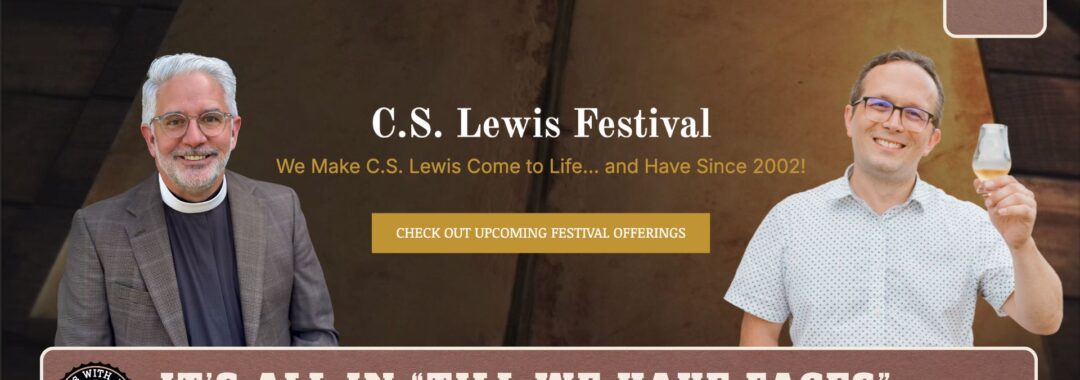
Welcome friends to Season 9! We’re kicking things off a little differently this time… Join us for the very first live live-streamed episode, hosted by the Petoskey C.S. Lewis Festival.
Click here to download audio for S9E1: “It’s All In Till We Have Faces”, After Hours with the Petoskey C.S. Lewis Festival
Show Notes
Introduction
Pints With Jack Theme Tune
- The theme by Matt Wheeler can be found here.
Quote-of-the-Week
Somehow what Lewis thought about everything was secretly present in what he said about anything.
Owen Barfield, The Taste of the Pineapple
Welcome
Welcome to Season 9 of Pints with Jack! It’s just David and Andrew today, Matt was not cool enough to join us.
Today’s episode is special for three reasons:
- This is the opener of Season 9, and we’ve dedicated this season to exploring Lewis’ prophetic work, “The Abolition of Man”.
- This is the first episode recording which was simultaneously live streamed to our Patreon supporters (folks who support what we do for as little as $2)…
- Lastly, this is a special episode because on today’s edition of After Hours, we are joined by our very first live, in-person audience, with the lovely people attending the C. S. Lewis Festival in Petoskey, Michigan. SAY HELLO EVERYONE!
Chit Chat
Some introductions for those who are new… Pints with Jack began in 2017 when David was at a party. He met his co-host Matt Bush (who was unable to make it to this festival), and discovered their mutual love of C. S. Lewis. They decided to read his works together over coffee or a pint of beer, which grew into a monthly book club with twelve other people. It was out of this book club that Pints with Jack was born, and as the seasons ticked by, Andrew hopped on board as well.
- David and Andrew have coveted an invite to the festival for some time. Walter Hooper, Douglas Gresham, Chris Mitchell, Sarah Arthur, Michael Ward, Diana Glyer, Wayne Martindale, David and Crystal Downing, and Jerry Root have all spoken here…and now, a couple of shlubs!
- Andrew talked about Petoskey and receiving the invite to the C. S. Lewis Festival, and the literary conversations that had happened so far in their time there, including:
- Literary Conversations, a three-part dissection of “Till We Have Faces” with Dr. Suzanne Shumway and Dylan Taylor
- A presentation of the documentary The Magic Never Ends: The Life and Faith of C.S. Lewis
- A screening of the movie Freud’s Last Session
- A guided prayer labyrinth walk through a lavender farm, by Andrew’s wife, Dr. Christin Ditchfield Lazo
- A talk by Andrew, called C.S. Lewis and the Myth of Love: Digging Deeper into Till We Have Faces
- The Story Within the Story: Exploring Spiritual Truths in The Chronicles of Narnia with Dr. Christin Ditchfield Lazo
- …and finally, The Art, Craft, and Ethics of Biography, an interview with Abigail Santamaria & Sarah Arthur.
- There was too many wonderful things at this conference to list here, but you can check them out for yourself at the C. S. Lewis Festival site.
- As David drove up to the UP from southern Wisconsin for this festival, he couldn’t help but ask, why on earth did we give this beautiful territory up? Must be reverting to his British roots.
- Andrew talked about when the C. S. Lewis Festival was held in Belfast, Ireland, and how beautiful the Antrim coast was. In the words of Irishman Lewis himself, “they satisfy themselves with making mud pies in a slum, because they cannot imagine what a holiday at sea might mean.” During this trip, Andrew saw the very same cottage where Lewis spent a few months.
Toast
The drinks for this episode were very special as we were supported by a local company and supporter of the festival, Beards Brewery. David asked them if they’d like to come up and tell everyone what they were drinking…
- They were planning on bringing a Lewis-themed craft beer called Out of the Silent Planet, after the first novel in Lewis’ sci-fi series. It’s a British-style pale ale, otherwise known as an ESB. However, due to life craziness, there was not enough time to brew it.
- Instead, Andrew drank The Midnight Peddler (an English-style porter), and David drank Deez Nuts brown ale. Porters were commonplace in pubs in Jack’s time.
- Today, we toast all the organizers, supporters, and attendees of the Petoskey C. S. Lewis Festival…cheers!
Discussion
01. “It’s all in TWHF”
- The origin of today’s episode’s title… comes from something which Diggory says at the end of “The Last Battle“:
“It’s all in Plato, all in Plato: bless me, what do they teach them at these schools!”
Diggory Kirk, C. S. Lewis, The Last Battle
- Whereas Diggory thought it was all in Plato, we suggest in this episode that really, it’s all in “Till We Have Faces”.
- The TWHF/TGD debate began when Andrew went on the All About Jack podcast and claimed that TWHF was Lewis’ best novel, and that it was present in some form within every Lewis book. As David and Matt were just about to begin TWHF themselves in Season 3 of Pints with Jack, they invited Andrew onto the show to discuss the book. Little did they know that Andrew would never stop talking about it.
- Since then, they’ve been at a stalemate. However, though Andrew has never convinced David that TWHF is Lewis’ best book, he has convinced him that the book shows up everywhere.
02. “Till We Have Parallels”
- The parallels to TWHF throughout Lewis’ corpus are endless. Here’s a list of just a few of them, comparing the book to “Perelandra”, which we went through last season:
- “Perelandra” is a retelling of the Creation narrative, and the Garden of Eden. TWHF is also a myth retold.
- Likewise, just as the Green Lady of “Perelandra” has to trust Maleldil (God), Psyche in TWHF has to trust the god of the mountain.
- The Un-Man in “Perelandra” is continuously attempting to twist love into pride, vanity, and self-exaltation. TWHF turns this on its head, in an attempt to untwist Orual’s disordered loves into something pure.
- The Perelandrian hero Ransom is scarred but glorified, and meets the ascended Lord and Lady. TWHF also ends with an encounter with royalty and the divine, and Orual’s transformation.
- Earlier in the day, Dr. Christin Ditchfield Lazo gave a presentation on the Narniad. The Narnia series is riddled with parallels as well.
- In “The Magician’s Nephew”, Diggory undergoes a test of obedience.
- In “Prince Caspian”, Aslan is initially invisible (like the palace), but can be seen by Lucy through here eyes of faith. Orual, by comparison, is blind, because she is prideful, and cannot see beyond herself, until she takes a posture of humility.
- This connection to Lucy actually goes deeper, so let’s explore it:
- When you read Narnia next, pay attention to how often Lucy is the first to notice things. It’s not just because of her faith; it’s because she loves. One such example of Lucy’s great love is her gift from Father Christmas. She received a cordial, filled with drink that revives the heart. Even the root of the word “cordial” means “heart”. In other words, Lucy’s gift is the heart. And it is because of her heart that she can heal, and be brave.
- Andrew noticed that the name “Lucy” (meaning “light”), is associated with sight in many ways, including St. Lucy, the patron saint of the blind. She is often depicted in iconography as holding her eyes in her hands or on a plate.
- Lewis owned an atlas as a boy, and in it, he marked the name of a town, where a blessed mystic named Lucy lived hundreds of years ago. The town’s name? Narni.
- “My own eyes are not enough for me, I will see through those of others.” – C. S. Lewis, An Experiment in Criticism
- This connection to Lucy actually goes deeper, so let’s explore it:
- In “The Voyage of the Dawn Treader”, Eustace has greedy, “dragon-ish” thoughts in his heart and is transformed into a dragon. He sees this in his reflection, much like Orual. He can only be restored at the hand (or claws) of Aslan.
- …all the way through to “The Last Battle”, “The Dwarves are for the Dwarves” and it leads them to spiritual blindness while the others leave the shadowlands, go to the New Narnia and see Aslan face-to-face.
- After all, as we learn in “The Magician’s Nephew”, “What you see and what you hear depends a great deal on where you are standing. It also depends on what sort of person you are.”
- Even in “The Pilgrim’s Regress”, the character John cannot see the country until his vision is purified.
03. “Till We Are Holistic”
Q. We’re going to be focusing on that last one in this episode… his most holistic work. so where would you like to begin Andrew?
- Earlier in this weekend, Andrew has put forward his “unified field theory” (UFT) of Lewis: that his work is Mythos & Logos (Story & Word), Claritas & Caritas (Clarity & Love).
- He also made his case for TWHF as Lewis’ best book, explaining how it’s…
- …a Modernist Novel
- …his best autobiography
- …his clearest Evangelium
- … and his most Holistic Book.
- To clear up confusion on the UFT, Andrew explained (sing an example from TWHF) how Lewis uses Logos & Mythos to help the reader see clearly. Ultimately, what we need to see most clearly is love. Specifically, the love that God has for each and every one of us, no matter our brokenness, but also what love looks like when it’s gone bad.
04. “Till We Have Love”
Q. Can you really find TWHF everywhere? What about some of his more obscure books?
- In May of 1940, Jack wrote to his brother Warnie about the four Greek concepts of love: philia, storge, eros, and agape. For most of his life, he’s been compelled to write about this most important thing called love. These different types of love and affection came to fruition in “The Four Loves”, but they are most holistically explained in TWHF, which Jack was righting simultaneously as he wrote TFL. In TWHF, he especially shows how these loves can go sour when not oriented towards God.
Love ceases to be a demon when it ceases to be a god.
C. S. Lewis (quoting Denis de Rougemont)
Emerson has said, “When half-gods go, the gods arrive.” That is a very doubtful maxim. Better say, “When God arrives (and only then) the half-gods can remain.” Left to themselves they either vanish or become demons.
C. S. Lewis, The Four Loves
- Andrew discussed the implications of love, including the commandment to love our neighbors – which includes our enemies – as ourselves, explaining how we must approach others when they’re in sin, or express a wrong point of view. We must also learn to love and be kind to ourselves, just as Orual, who once hated herself, learned to do.
- David pointed out that the section on love in “Mere Christianity” stood apart from the others in terms of its greatness, for it’s instruction to help others be the best version of themselves through loving them. We do this for ourselves, so we must do it for our neighbors as well.
- In TWHF, Orual is incapable of loving others and speaking tenderly to them, because she doesn’t know how to treat herself with kindness.
- This appears in other Lewis books as well, such as “That Hideous Strength”, where the character Jane Studdock has to learn how to love her husband again, through Ransom’s guidance.
- This theme also runs throughout the entire plot of “The Great Divorce” (Lewis’ REAL best book), but particularly in the chapter with the ghost Pam. This spirit is willing to drag her son into hell with her if it means she can have him, and justifies it under the guise of “mother love”.
All the worst pleasures are purely spiritual: the pleasure of putting other people in the wrong, of bossing and patronising and spoiling sport, and back-biting; the pleasures of power, of hatred. For there are two things inside me, competing with the human self which I must try to become. They are the Animal self, and the Diabolical self. The Diabolical self is the worse of the two. That is why a cold, self-righteous prig who regularly goes to church may be far nearer to hell than a prostitute. But, of course, it is better to be neither.
C. S. Lewis, Mere Christianity
- Lewis teaches us that we must learn to love ourselves by looking beyond ourselves to other people. Andrew brought up Christ rebuking the Pharisees, to get them to overcome their self-righteousness.
“You brood of vipers! How can you speak good, when you are evil? For out of the abundance of the heart the mouth speaks.”
Matthew 12:34
- Andrew talked about his own experience with being humbled by his journey through Christianity, eventually ending up in the Episcopal church and becoming a pastor.
05. “Till We Have Vision”
Q: Another big theme in Lewis’ work is God’s hiddenness and divine silence. It’s a question he explores at length in “A Grief Observed” in the wake of his wife’s death. As an autobiographical author, Lewis threads this complaint throughout TWHF as well. Why is this?
When you are happy, so happy you have no sense of needing Him, so happy that you are tempted to feel His claims upon you as an interruption, if you remember yourself and turn to Him with gratitude and praise, you will be — or so it feels— welcomed with open arms. But go to Him when your need is desperate, when all other help is vain, and what do you find? A door slammed in your face, and a sound of bolting and double bolting on the inside. After that, silence.
C. S. Lewis, A Grief Observed
- Lewis described his wife’s final moments, where she turned to smile, not at him, but at God.
“How wicked it would be, if we could, to call the dead back! She said not to me but to the chaplain, ‘I am at peace with God.’ She smiled, but not at me. Poi si torno all’ eterna fontana.”
C. S. Lewis, A Grief Observed
06. “Till We Have Myth”
Q. The last thing I wanted to touch on is this idea of “a myth retold…”
- Returning to “a myth retold”, Lewis often catches the reader unawares in order to explain deeper theological concepts in a digestible way. This is such a big theme in Narnia, where we learn about Aslan in this imaginative world, so that we may know him better in reality.
- Stories take us out of ourselves into something bigger, reminding us that we were made for more.
If I find in myself a desire which nothing in this world can satisfy, the only logical explanation is that I was made for another world.
C. S. Lewis, Mere Christianity
- Andrew shared that speaking at C. S. Lewis conferences are the closest thing he knows to heaven, because they’re opportunities to talk about the things found in the depths of our souls. Perhaps when he passes through the pearly gates, he’ll come across some corner of heaven and say “this reminds me of Petoskey!”
07. “Till We Have Consequences”
Q. To put a bow on this discussion, “so what”? How does our understanding of “Till We Have Faces” as Lewis’ most holistic book change our reading of TWHF and the rest of his works?
- The most central theme throughout the book is God’s mercy and relentless love, even when we are in our ugliest, most deplorable state.
- TWHF is a deliberate concentration of all of the richness of Lewis, his final and most comprehensive fiction novel, written at the behest of his wife, Joy Davidman. Everything is a meaningful crescendo towards the end, which is ultimately God’s love for us.
- Andrew explained that the struggle, beauty, and love strewn throughout the book is what keeps him coming back to it time and time again: it is a constant reminder of the most beautiful things in life.
- David talked about the feelings-based modern literature movement that Lewis fought against, that says that books are independent of one another, and how you feel about each one is completely subjective. Instead, Lewis saw literature as an interactive web, with books “speaking” to one another across time, language, and authors. By looking at books in this way, we not only expand our knowledge, but our understanding of other books and authors. We also subsequently expand our bookcases, as we run into more through our reading.
- Andrew discussed his time teaching at the Summer Institute, where TWHF touched a student so deeply that she would run weeping from the room. During this time, a man approached him, saying that he and his wife would read the novel over their anniversary, and that they “couldn’t wait to read this book about love together.” He explained how the book meets people where they are, in joy and in pain. It forces us to confront the love of God, the most important thing in the world.
Wrap Up
Concluding Thoughts
- Thanks to the C. S. Lewis Festival for inviting us. If you (the reader) want to learn more about the C. S. Lewis Festival – or attend next year’s conference – visit their website.
Support Us!
- Subscribe to the audio feed on your preferred podcast platform, such as iTunes, Google Podcasts, Spotify, Audible, and many others…
- Follow us on Instagram, Facebook, YouTube, and Twitter
- See what we have planned for the rest of Season 9
- We would be grateful if new listeners would rate and review us on their preferred podcast platform.
- Finally, if you’d like to support us and get fantastic gifts such as access to our Pints With Jack Slack channel and branded pint glasses, please join us on Patreon for as little as $2 a month.