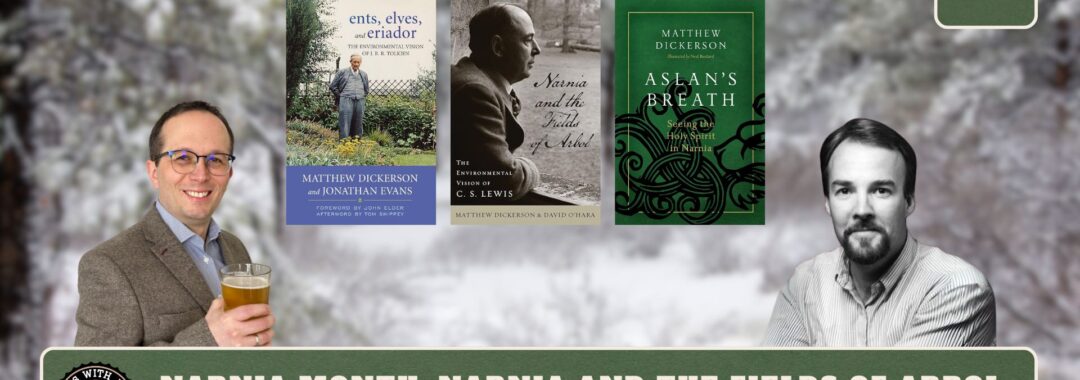
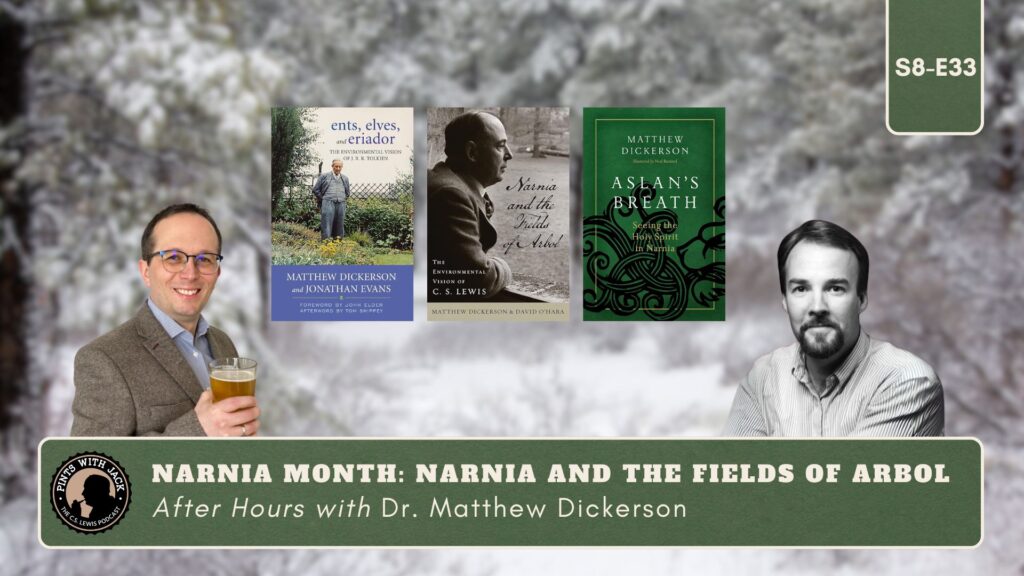
Dr. Matthew Dickerson comes on the show to discuss the ecology of J. R. R. Tolkien and C. S. Lewis.
S8E33: “Narnia Month: Narnia and the Fields of Arbol”, After Hours with Matthew Dickerson (Download)
If you enjoy this episode, please subscribe on your preferred podcast platform, such as iTunes, Google Podcasts, Spotify, Audible, and many others…
For information about our schedule for Season 8, please see the our season roadmap, containing a list of all the episodes we plan to record together, as well as “After Hours” interviews with special guests.
Finally, if you’d like to support us and get fantastic gifts such as access to our Pints With Jack Slack channel and branded pint glasses, please join us on Patreon for as little as $2 a month.
Show Notes
Introduction
Quote-of-the-Week
Tolkien once remarked to me that the feeling about home must have been quite different in the days when a family had fed on the produce of the same few miles of country for six generations, and that perhaps this was why they saw nymphs in the fountains and dryads in the wood-they were not mistaken for there was in a sense a real (not metaphorical) connection between them and the countryside. What had been earth and air & later corn, and later still bread, really was in them. We of course who live on a standardized international diet (you may have had Canadian flour, English meat, Scotch oatmeal, African oranges, & Australian wine today) are really artificial beings and have no connection (save in sentiment) with any place on earth. We are synthetic men, uprooted. The strength of the hills is not ours.
C. S. Lewis, Letter to Arthur Greeves, June 22nd, 1930
Biographical Information
Today, we will be speaking with perhaps the most well-known man in the study of Lewisian and Tolkienian ecology, Dr. Matthew Dickerson.
Dr. Matthew Dickerson is Professor at Middlebury College in Vermont where he is a member of the Computer Science department, an affiliate of the Environmental Studies program, and a regular teacher of writing and literature classes for both the First Year Seminar Program and the Program of Writing and Rhetoric. He is coauthor of many books, including three which we’re sure to touch on today, including “Ents, Elves, and Eriador: The Environmental Vision of J. R. R. Tolkien”, “Narnia and the Fields of Arbol: The Environmental Vision of C. S. Lewis”, and “Aslan’s Breath: Seeing the Holy Spirit in Narnia”.
Chit-Chat
Q: Because Matt’s not here I have to ask this question for him. What would you say is your favourite OS, programming language, and large language model or AI system?
- Dr. Dickerson likes MacOS, although he’s becoming a little less happy as time goes on and changes are made. Based on his cross with ecology and agent-based modelling, he enjoys Net Logo, which is a programming language made for that purpose. As for the third part of the question, he avoids LLMs for moral and ethical reasons,
Toast
- Dr. Dickerson is making his own drink; he is currently brewing a (homegrown) rhubarb mead with honey harvested from his own hives. But until that is done fermenting, he is sipping his afternoon tea.
- David had a Sunset Stoke NA IPA from Athletic Brewing Company.
Discussion
01. “Dr. Dickerson’s Background”
Q: Would you first of please introduce yourself to our listeners, explaining your background with the Inklings, as well as how the worlds of Computer Science and Environmentalism came together in your life?
- In graduate school, Dr. Dickerson did work in both computer science and Old English language and literature at Cornell. This second field of study was under the guidance of Dr. Robert Farrell, who studied at Oxford in the time of J. R. R. Tolkien, and had a personal relationship with him. His work with Dr. Farrell led to the publication of two medieval historical novels that included some of Dr. Dickerson’s own work and translations.
- Dr Dickerson’s interest in care for the environment stems from the Biblical decree to steward God’s creation, as His image-bearers and disciples. This goes all the way back to Genesis 2, which uses the Hebrew word “shamar”, which means “to keep and guard”, and often refers to God’s promise to tend to His people, the Israelites.
Q: Did you grow up reading the Inklings’ works, or was that a later discovery?
- Dr. Dickerson’s mother worked as a 5th grade public school teacher for many years, and would read the entire Narnia series to her class. When Dr. Dickerson was around the same age as her students, she began reading them to her son as well. Another middle school English teacher of his read “The Hobbit” to the class.
- His dad was another influential figure, as he owned an operated a book store, and would pay his son in books whenever Dr. Dickerson would work there. As his teacher was moving too slowly for his liking, he picked up his own copy of “The Hobbit”, then quickly moved through Tolkien’s corpus, including “The Lord of the Rings” and “The Silmarillion”, as soon as it was published. The later has become one of his favourite pieces of literature.
Q: At what point did you decide to begin writing books about this?
- The first class that Dr. Dickerson co-taught was at Cornell, on the person of Tolkien. While his other professor taught on horror literature, Dr. Dickerson discussed fantasy, including the father of high-fantasy.
- One day, as he taught classes on computer science and literature at Middlebury, a publisher showed up asking him if he was willing to write a book on Tolkien. After sending a proposal, he received a contract offer, and the rest is history. His work, “A Hobbit Journey”, was a top finalist for the Mythopoeic Society’s Best Work of Scholarship of the Year Award on Inkling studies.
02. “Tolkien’s Vision”
Q: We’ll get to Lewis in a moment, but let’s start with J. R. R. Tolkien. You wrote the book “Ents, Elves, and Eriador: The Environmental Vision of J. R. R. Tolkien” with Jonathan Evans. Would you mind giving us, in broad strokes, Tolkien’s environmental vision?
- Together, Dr. Dickerson and Evans present Tolkien’s environmental vision in three parts:
- Sustainable agriculture;
- Caring for the wilderness;
- A derivative of horticulture.
Q: What formed this vision in him, and how did it manifest in his works?
- There were a few major events that formed this vision for Tolkien. After spending much of his youth in the countryside – the UK equivalent of the Shire – he moved with his mother and brother into the city, leaving behind the woods. Another seismic event was the introduction of mass-scale industrialisation. Finally, he – along with many of the other Inklings – lived through multiple world wars. The toxicity of the trenches would forever plague his body, but also his memory, and he certainly would remember how the bombs and poisonous mustard gas would turn the landscape into an uninhabitable mud pit.

- His deeply rooted belief in the conservation and protection of nature also stemmed from his Catholic faith, particularly from the Creation account. There have been several monastic traditions that are nature-focused, particularly the Franciscans. It is possible that Tolkien (loosely) based the wizard Radagast off of this saint!
- Tolkien saw the destruction of the wilderness of his childhood as a travesty, and was strongly against ravaging nature for personal gain. One area we see this most profoundly in his works is in the creation of the Ents, who are guardians of the trees against the abuses of men and other creatures, such as Saruman, whose reign in Isengard is incredibly destructive.
- Another example comes at the end of the series, as the hobbits return to a ravished Shire. Lotho Sackville-Baggins turned hobbit local agriculture into an agro-business, with the food exported to foreign locations.
Q: How unique was Tolkien in his point of view? Were there others in his circle or who lived in his time who shared the same vision?
- Tolkien was certainly ahead of the times. One writer who lived at the end of Tolkien’s life who shared his vision was Rachel Carson, author of “Silent Spring”. Another author who ushered in a revolution in recovery land management was Aldo Leopold, who wrote “A Sand County Almanac”. Owen Barfield even contributed his own vision in “Eager Spring”, which is cut from the same cloth as the rest.
03. “Lewis’ Vision”
Q: Moving on to C. S. Lewis, you co-authored “Narnia and the Fields of Arbol” with David O’Hara, where you explore Lewis’ environmental vision. As with Tolkien, in broad strokes, what was it?
- Lewis held similar views as his friend. In both the Ransom trilogy and in Narnia, the downfall of civilisation begins with deforestation, explicitly for commercial export and self-enrichment.
- As seen in “The Magician’s Nephew”, Lewis sees nature through the lens of the Creation narrative; as a good work of a good Creator. Even the trees have souls in his Narnian world. But the nature-preserving vision is most explicit in the Ransom trilogy, particularly in“That Hideous Strength”, as a prominent character Andrew MacFee advocates for resisting greedy and exploitative global powers through communal living, care for the land, and welcoming the stranger and refugee.
- As we saw this season, Ransom has a respect for the new world he finds himself in in Perelandra. Though the fruit of the world is beyond earthly compare, he thinks it wrong to overindulge and engage in the sin of gluttony. It feels as though he would be exploiting the land somehow.
Q: Once again, what formed this environmental vision in him?
- His change in thinking directly correlates to his conversion to Christianity. Prior to this, the atheist Lewis was very rationalist and gnostic regarding nature, as seen in his letters. After, he began to see the natural world as good and purposefully made.
- Lewis often introduces people to the connection between the physical and the spiritual through sacraments. These physical things are the means by which God pours out His grace and blessings.
04. “Aslan’s Breath”
Q: Sticking with Narnia a little longer, your most recent book has been “Aslan’s Breath: Seeing the Holy Spirit in Narnia“. The role of the Holy Spirit in Narnia is something that I’ve discussed with the hosts of The Lamp-post Listener podcast, but how does this book connect with today’s subject of the environment?
- In ancient Hebrew and Greek, the word for “spirit” is the same as the word “breath”. The clear place that the Holy Spirit appears is in the breath of Aslan, along with his anointing kiss. There is even something about the very air of Narnia that rejuvenates all peoples who come there. It seems the Holy Spirit is “everywhere present and filling all things”.
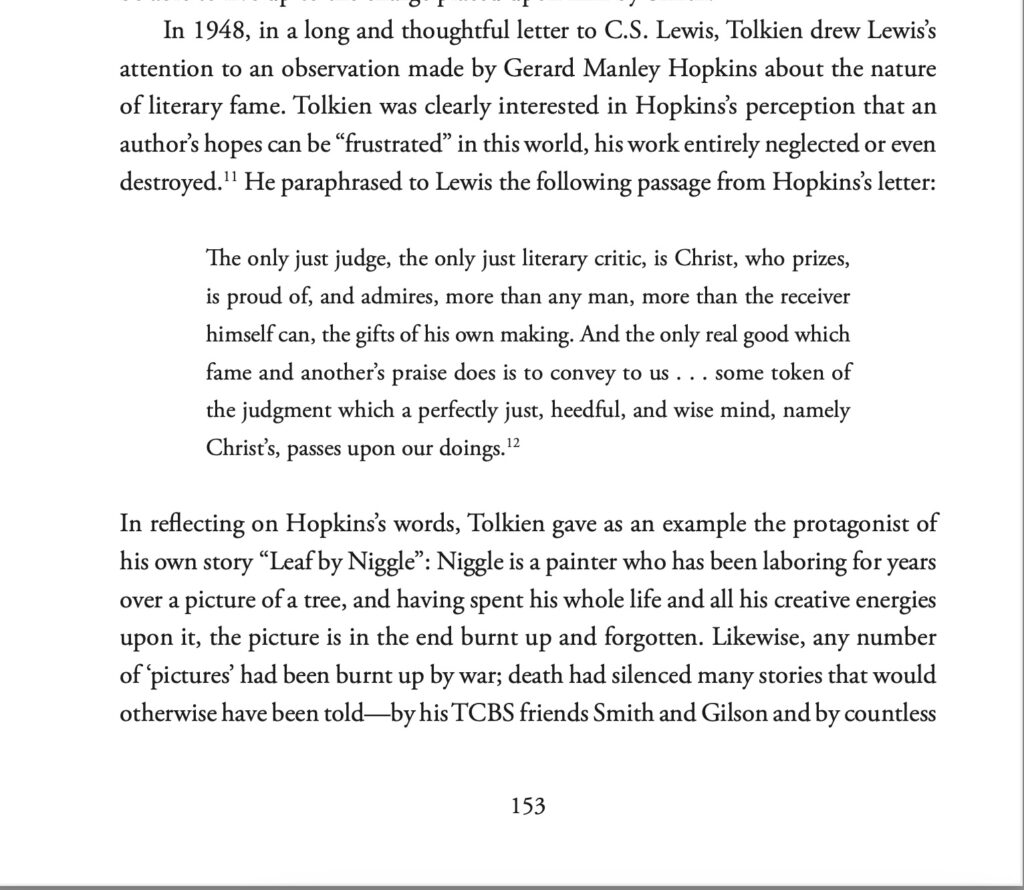
- Dr. Dickerson recalled reading “Christ Plays in Ten Thousand Places” and “As Kingfishers Catch Fire” by Eugene Peterson, based on the poem by Gerard Manly Hopkins, which both discuss the role of the Holy Spirit in our lives. Just as the Spirit is recognisable in our everyday lives, He is present throughout the Chronicles of Narnia.
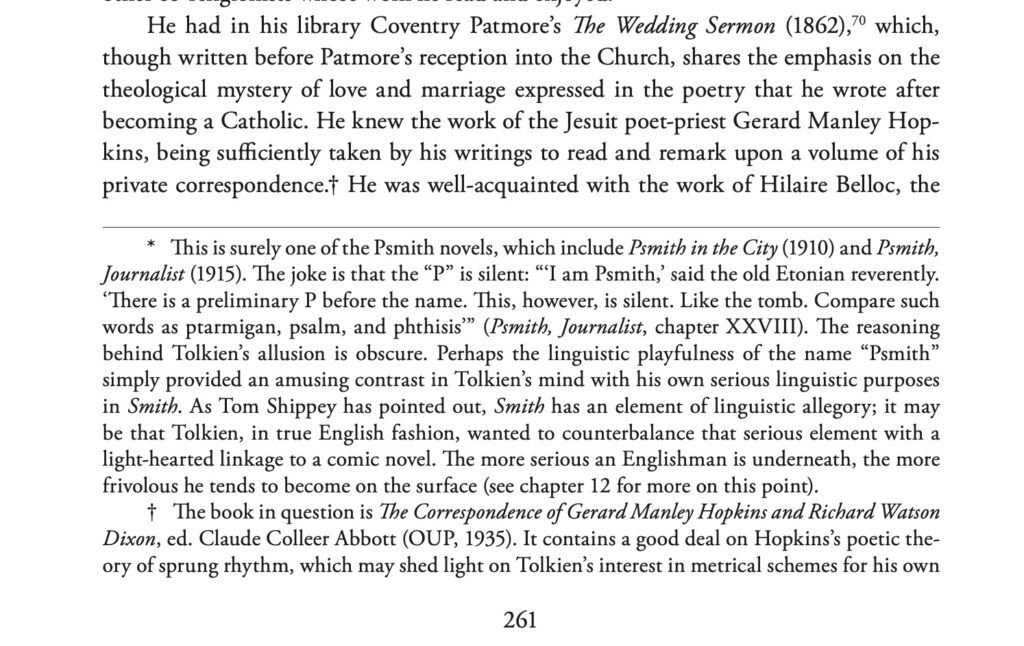
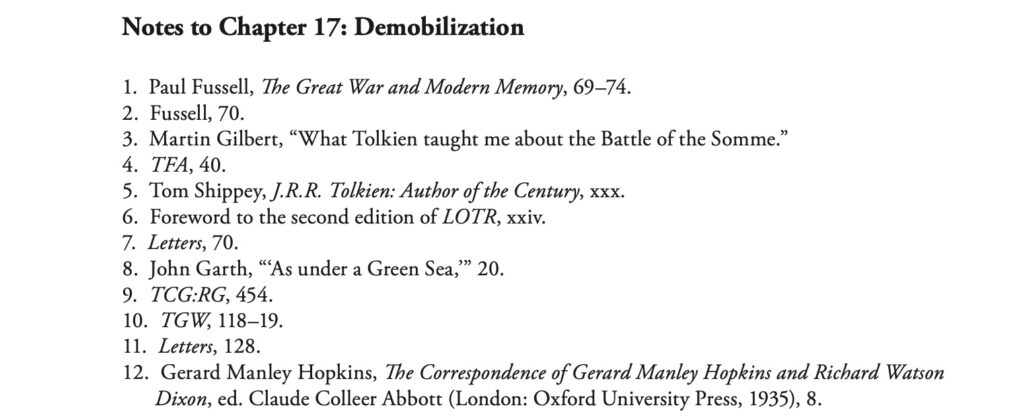
25-June-25 Update: David asked Dr. Ordway about Tolkien’s relationship with Hopkins and she said “I have found no evidence of T. quoting Hopkins, but we know that he was familiar with his work, by referencing a passage in a volume of Hopkins’ letters. See Tolkien’s Modern Reading p. 261-62; I expand upon the reference in the letter in Tolkien’s Faith“
- To be shaped by the Holy Spirit is to grow in the virtues Christ lived out, including humility, gentleness, and compassion. It means living as a servant, with others best interest in mind and placed above your own. This is exemplified in story form in the character Frodo, who choses to save the Shire, not for himself, but for others.
“I should like to save the Shire, if I could – though there have been times when I thought the inhabitants too stupid and dull for words, and have felt that an earthquake or an invasion of dragons might be good for them. But I don’t feel like that now. I feel that as long as the Shire lies behind, safe and comfortable, I shall find wandering more bearable: I shall know that somewhere there is a firm foothold, even if my feet cannot stand there again.”
J. R. R. Tolkien, Frodo Baggins, The Lord of the Rings
- Lewis also discusses this concept of transformation and reception of divine grace in “Mere Christianity”:
If you want to get warm you must stand near the fire: if you want to be wet you must get into the water. If you want joy, power, peace, eternal life, you must get close to, or even into, the thing that has them.
C. S. Lewis, Mere Christianity
- Hopkins was another writer who cared deeply for the environment, as evidenced by his poetry. Tolkien was actually connected to the poet through the man’s nephew. He likely read Hopkins’ poetry, with some of his own writing greatly reflecting Hopkins’, such as “Bregalad’s Lament”, in comparison to “Binsy Poplars”. The Tolkien scholar, Dr. Holly Ordway, wrote an annotated collection of Hopkins’ poems, which you can find here.
05. “The Soil of Lothlorien”
- Upon their return from their quest, the Fellowship is tasked with the cleansing of the Shire. However, Samwise is given a second task; to spread soil from Lothlorien – a gift of the elf Galadriel – throughout the land. As he does so, the land is greatly enriched, one might say blessed. Tolkien appears to be saying that soil is a holy thing to be cared for, and seen as a gift.
Wrap Up
Concluding Thoughts
- Dr. Dickerson encouraged listeners to be attentive to both the creation and the Creator, as both Tolkien and Lewis invite us to be.
Haldir had gone on and was now climbing to the high flet. As Frodo prepared to follow him, he laid his hand upon the tree beside the ladder: never before had he been so suddenly and so keenly aware of the feel and texture of a tree’s skin and of the life within it. He felt a delight in wood and the touch of it, neither as forester nor as carpenter; it was the delight of the living tree itself.
J. R. R. Tolkien, The Fellowship of the Ring
- His most recent book, “Birds in the Sky, Fish in the Sea”, is a theology and practice of attentiveness to creation, and tending to it.
More Information
- Dr. Dickerson’s books can be found at any book store; he especially encourages supporting independent shops!
- Dr. Dickerson’s website